Cash Flow Software: The 10 Best Tools Compared for 2026
Professional financial planning does more than just protect against cash shortages; it is a key driver of long-term growth. Specialized cash flow software helps you keep an eye on your liquidity at all times, identify bottlenecks early, and take targeted countermeasures. At the same time, it supports strategic investment decisions and enables forward-looking financial planning. As the provider of Tidely, we are convinced that our cash flow management software is one of the best solutions on the market. However, we know that every company has different requirements. That is why you will find an objective comparison of the best tools for 2026 here, so you can choose the solution that truly fits your needs. To create this, we reviewed the websites of various providers, multiple comparison sites, and user reviews, and summarized our findings here.
Key takeaways
- 22,027 corporate insolvencies were filed between January and November 2025 alone, a 10% increase compared to the same period the previous year (Destatis, February 2026). A common trigger is a liquidity crunch, not a lack of profitability.
- Tidely and Commitly are suitable for SMEs focusing on real-time insights and short-term liquidity planning. Agicap is aimed at larger companies with an expanded range of functions (price on request, higher price segment).
- Most important selection criterion: operational liquidity planning in real-time (Tidely, Commitly, finban) versus strategic controlling and BI (Board, Helu, companyon). These are fundamentally different product categories with different use cases.
- Free alternatives like Excel templates are only suitable for very simple structures. They do not offer real-time data and must be updated manually, which becomes error-prone as the number of transactions grows.
Jump straight to the tool comparison >
What is cash flow and cash flow management?
Cash flow refers to all incoming and outgoing payments of a company within a specific period. It shows how much liquid capital is actually available, regardless of whether the company is profitable.
Although the terms cash flow management, liquidity management, and liquidity planning are often used synonymously, they describe different levels:
- Cash flow management controls daily incoming and outgoing payments and ensures that the company remains solvent in the short term.
- Liquidity planning is the systematic forecasting of future cash flows on a weekly or monthly basis and forms the basis for all financial decisions.
- Liquidity management encompasses the overarching strategy to secure long-term solvency, for example through credit lines, payment terms, or receivables management.
A company can be profitable and still become insolvent if payments are received too late to cover current liabilities. This is precisely the most common trigger for corporate insolvencies.
The most important tip when choosing a tool: Many software solutions cover cash flow as a secondary topic, with their focus on historical accounting analysis or comprehensive controlling. Tools built primarily for liquidity planning and real-time cash flow management (like Tidely or Commitly) deliver significantly more precise results here than all-in-one solutions.
Why is cash flow software important?
Without a specialized tool, most SMEs manage their cash flow in Excel. The problem: Every spreadsheet must be updated manually, bank data is never up-to-the-minute, and forecasts are based on manual entries.
A cash flow tool automatically links all bank accounts and accounting systems, displays cash flows in real-time, and detects impending bottlenecks before they occur. For SMEs and start-ups, this is particularly critical because even a single delayed payment from a major client can jeopardize solvency.
A survey of 125 Tidely users shows just how big the practical difference is:
- 73% of the surveyed companies work on their liquidity planning at least once a week.
- With Tidely, the time required for this is reduced by an average of 51% per week, which corresponds to about 4 hours.
- 85% of users plan to continue using Tidely after their subscription expires.
- The most frequently used Tidely features are cash flow planning with scenarios (79%), the dashboard (53%), and the account overview (42%).
Requirements for modern cash flow management software
Not every software with "cash flow" in its name is suitable for liquidity planning. You should check these six criteria when making your selection.
Integration with bank accounts and accounting systems.
Cash flow software must automatically synchronize bank accounts, ERP, and accounting systems. Manual data transfer is error-prone and makes real-time analysis impossible. Tidely supports over 5,000 bank connections as well as common systems like Lexoffice and sevDesk.
Real-time data instead of outdated accounting data.
Yesterday's cash flow status does not help with a liquidity gap today. Good software shows the current account balance and open items in real-time, not just the posted closing entries from the accounting department.
Scenario planning and forecasting.
The software should make it possible to play through different scenarios (scenario planning), for example: What happens if a major client pays 30 days late? What if a planned investment is brought forward? Without this function, cash flow management is reactive rather than proactive.
Automation of recurring tasks.
Transactions are automatically categorized by AI, forecasts are continuously updated, and it is all transparent: All AI-generated values can be manually adjusted and are traceable at any time. No black box, but smart support that you fully control. According to the Tidely customer survey, companies save an average of 51% of the weekly time spent on liquidity planning as a result.
User-friendliness without prior financial knowledge.
The software is not only used by CFOs, but often also by founders or managing directors without an accounting background. An intuitive interface is therefore not a nice-to-have, but a prerequisite for actual usage.
Visual dashboards and exportable reports.
Cash flow data must not only be understandable internally, but also communicable to banks, investors, or tax advisors. Dashboards with key KPIs and one-click exports are essential for this.
The 10 best cash flow tools compared for 2026
Good cash flow software needs to be a good fit for you, not just in terms of features, but also usability and cost. Whether you are looking for a simple tool for a daily liquidity overview, a complete cash flow management suite with ERP integration, or a specialized tool for cash flow planning and scenario analysis: requirements vary significantly depending on company size and maturity.
Here, we present the 10 best cash flow tools for 2026, along with their key pros and cons.
1. Tidely

⭐️⭐️⭐️⭐️⭐️ 4.5 / 5
141 reviews on OMR
Price: From €45.00 / month
Demo: Yes, 1:1 product presentation
Free trial access: 7 days
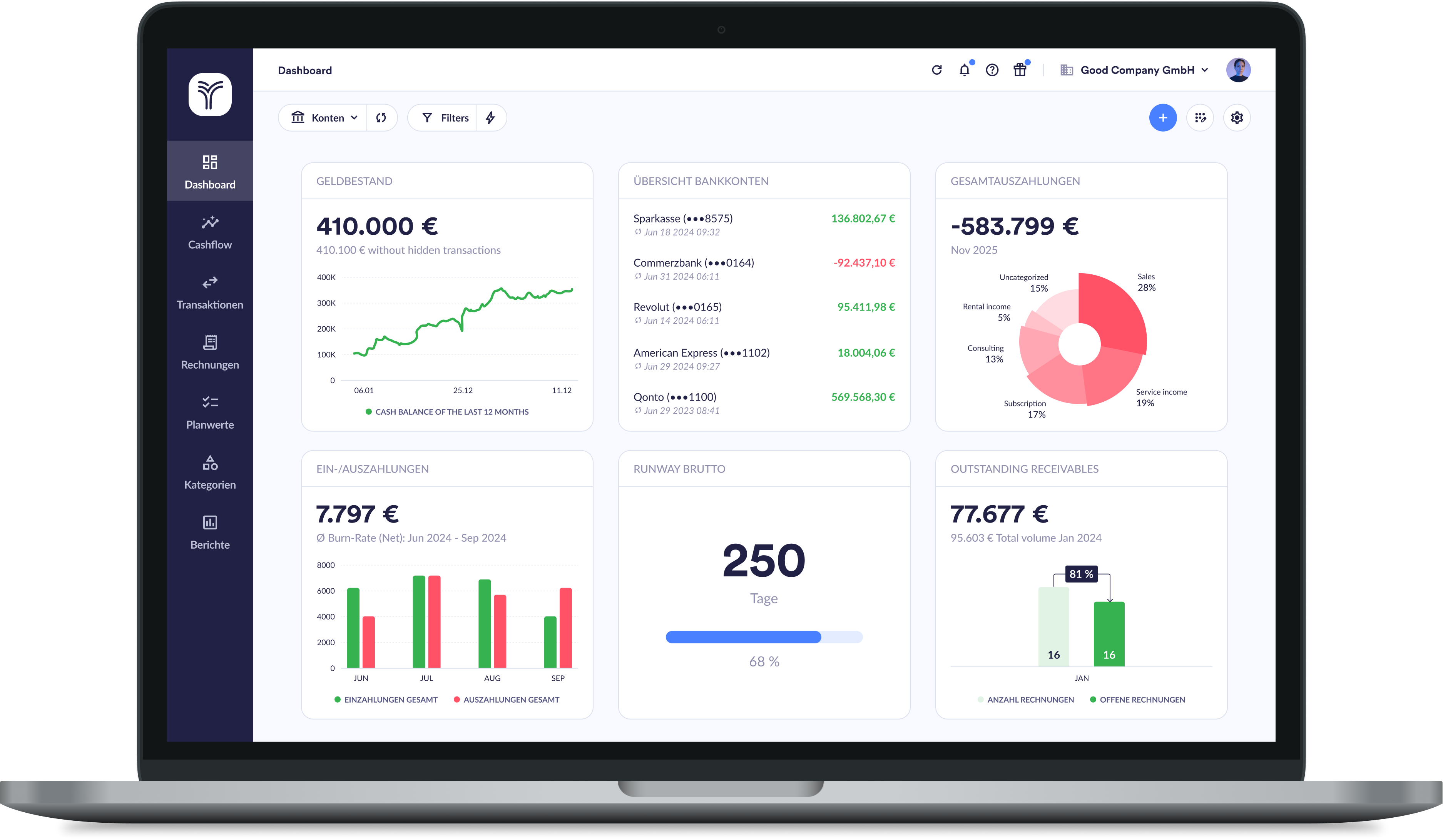
Tidely is a cash flow management software developed in Germany for SMEs and scale-ups. The software connects over 5,000 bank accounts as well as common accounting systems, synchronizing financial data automatically and in real time. More than 1,500 companies actively use Tidely for liquidity management.
Advantages of Tidely:
- Quick start without financial expertise.
Bank accounts and accounting systems can be connected in just a few minutes. According to Tidely, the first reliable liquidity forecasts are available within 15 minutes of setup. - Broad integration and automation.
Tidely supports standard integrations with DATEV, Lexoffice, sevDesk, Xentral, Weclapp, Moco, easybill, BuchhaltungsButler, Billomat, GetMyInvoices, and Microsoft Dynamics 365 Business Central. Through the DATEV integration, your open items (OPOS) are synchronized automatically, keeping receivables and payables up to date without manual exports. Additionally, PayPal, EBICS accounts, credit card providers, as well as an open API and Zapier connection are available. Transactions are automatically categorized using AI. - AI-powered forecasts and scenario analysis.
Tidely creates liquidity forecasts as actual-vs-target comparisons on a daily, weekly, or monthly basis. Users can run through scenarios, such as delayed customer payments or brought-forward investments, to identify liquidity risks early. - Time savings through automation.
According to a survey of 125 Tidely users, the weekly time spent on liquidity planning is reduced by an average of 51%, which corresponds to about 4 hours per week. - Cash flow reports at the touch of a button.
Detailed reports for banks, investors, or tax advisors can be exported as PDF or Excel with a single click. This is particularly relevant for companies that regularly conduct financing discussions. - GDPR compliant, ISO/IEC 27001:2013 standards, and hosted in Germany.
Tidely was developed in Germany and is hosted there. All data is processed according to GDPR standards. - Personal onboarding and German-speaking support.
In the Starter and Professional plans, new customers receive live group onboarding; from the Business plan onwards, they receive 1:1 onboarding from a Tidely expert. Support is available via email, chat, and phone, supplemented by video tutorials, a knowledge base, and 24/7 assistance from a trained AI chatbot.
Disadvantages of Tidely:
- Focus on the European market.
Tidely supports over 5,000 European bank connections. Companies that work primarily with banks in the USA or Asia may find better account coverage with local providers. - ERP integration only from the Professional plan onwards.
Connecting accounting systems is only available in the Professional, Business, and Enterprise plans, not in the Starter package.
How much does Tidely cost?
Tidely offers four packages:
- Starter from €45 / month: 1 bank account, with AI categorization and AI cash flow forecasting, 3 KPI widgets & live group onboarding
- Professional from €85 / month: 5 bank accounts, accounting integration, 2 team members, live group onboarding
- Business from €215 / month: 10 bank accounts, up to 3 companies, 5 team members, and personalized live onboarding
- Enterprise available upon request for large corporate structures with an unlimited number of accounts, companies, and a dedicated consultant.
The prices are transparent and without hidden additional costs. A free trial access is available for 7 days.

2. Agicap
⭐️⭐️⭐️⭐️⭐️ 4.6 / 5
169 reviews on OMR
Price: Upon request
Demo: Yes
Free trial: Yes
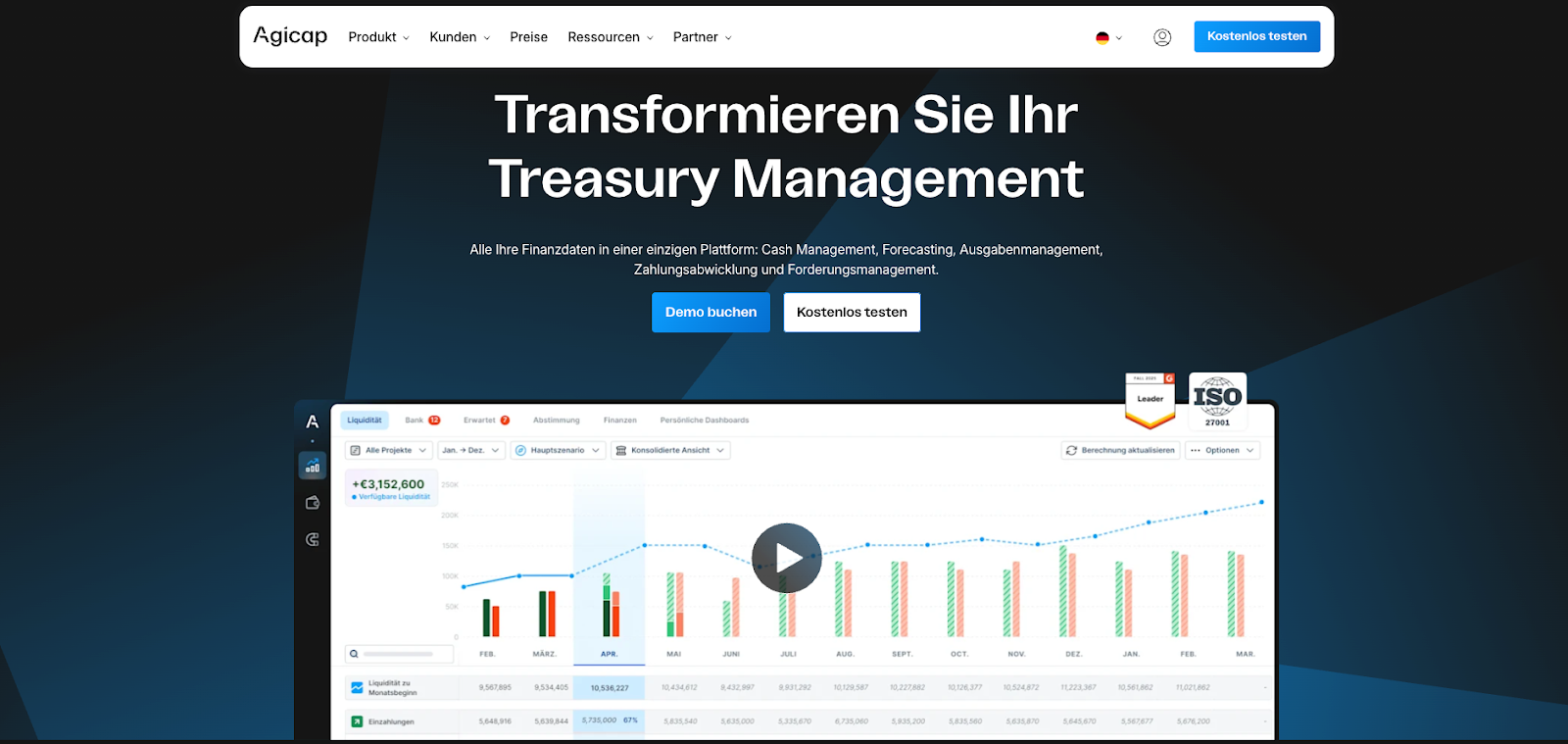
Agicap is a SaaS solution from France and one of the best-known European providers in the field of cash flow management. The software is primarily aimed at medium-sized companies and corporate groups with multiple entities, banks, or currencies. Core functions include real-time cash flow monitoring, automatic categorization, scenario planning, and a consolidated group view across all business units.
Advantages of Agicap:
- Comprehensive functional depth for complex structures.
In addition to classic cash flow management, Agicap offers modules for dunning (CashCollect), expense management, cash pooling, and AR/AP automation—ideal for companies that want to centralize their entire treasury management in one tool. - Group consolidation at the touch of a button.
Companies with multiple entities can switch between a consolidated group view and a detailed view of individual entities with a single click. - 13-week forecast and rolling forecasts.
Daily cash flow forecasts, flexible scenario modeling, and variance analysis at the group, department, or individual level directly in the dashboard.
Disadvantage of Agicap:
- Hohe Einstiegshürde für kleinere Unternehmen.
Agicap richtet sich an mittelständische Unternehmen mit dedizierten Finanzteams. Für KMUs ohne Finanzspezialisten kann der Funktionsumfang zu komplex und der Preis schwer zu rechtfertigen sein. Nutzerreviews auf Capterra und GetApp bestätigen diesen Punkt regelmäßig. - Modularer Aufbau kann teuer werden.
Funktionen wie Mahnwesen oder Ausgabenmanagement sind separate Module. Wer den vollen Funktionsumfang nutzen will, zahlt entsprechend mehr.
Wie viel kostet Agicap?
Die Kosten von Agicap sind auf Anfrage erhältlich und richten sich nach den individuellen Anforderungen, bewegen sich jedoch im höheren Preissegment, was für kleinere Unternehmen oder Start-ups eine finanzielle Hürde darstellen kann. Außerdem gibt es viele kostenpflichtige Module und Add-ons.

3. Commitly
⭐️⭐️⭐️⭐️⭐️ 4.8 / 5
140 reviews on OMR
Price: From €45.00 / month
Demo: No
Free trial: 14 days
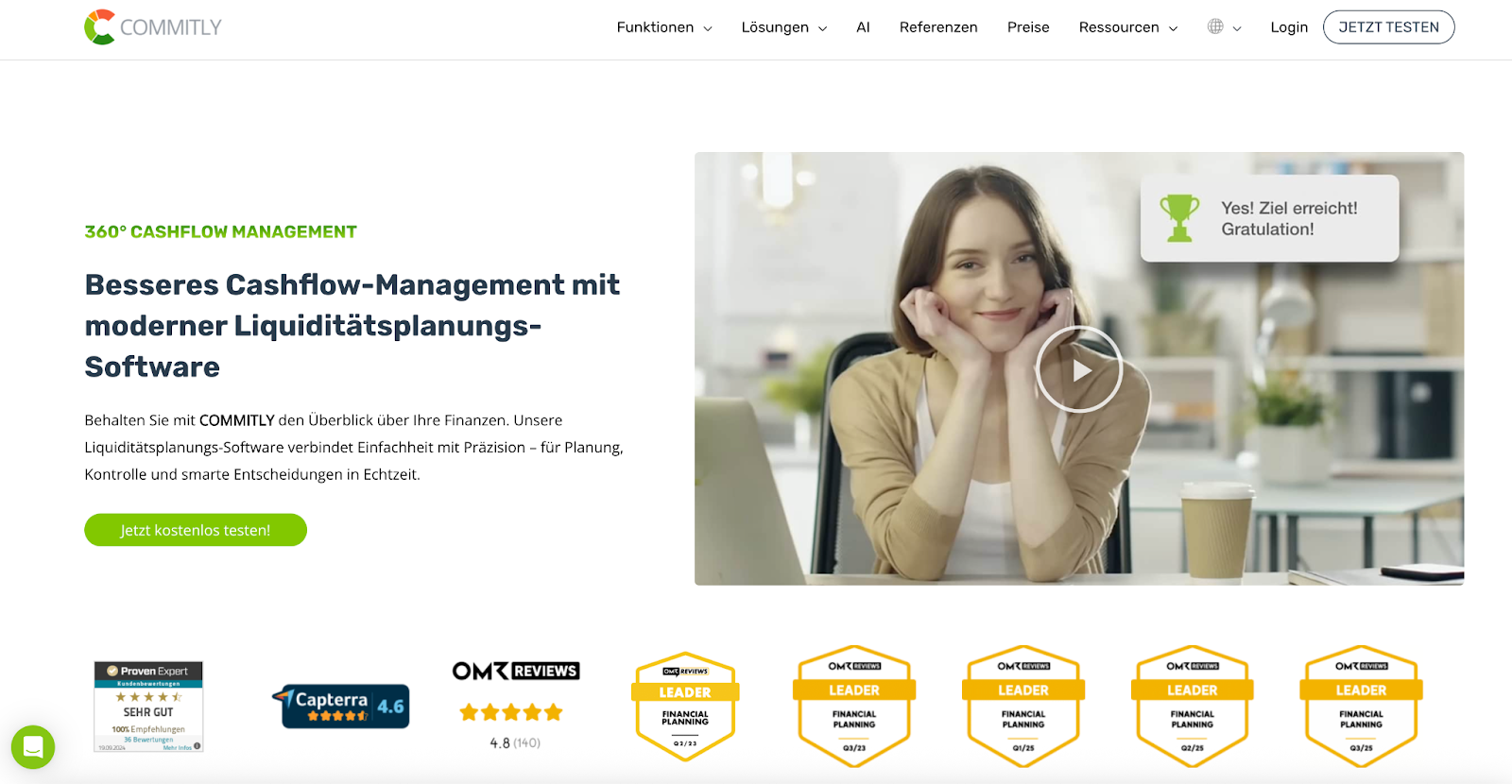
Commitly ist eine auf Liquiditätsplanung spezialisierte Software aus Deutschland und Österreich, die ähnlich wie Tidely auf Echtzeit-Cashflowmanagement und automatisierte Forecasts setzt. Die Software richtet sich an KMUs und Finanzexperten, die eine schlanke und fokussierte Lösung suchen.
Vorteile von Commitly:
- Szenarioplanung und automatisierte Forecasts.
Commitly ermöglicht die Simulation verschiedener Szenarien, automatische Forecast-Berechnungen und Soll-Ist-Vergleiche. Varianten eines Plans lassen sich mit wenigen Klicks erstellen, inklusive prozentualer oder absoluter Fortschreibung auf Folgeperioden. - Solide Bankanbindung für DACH-Unternehmen.
Commitly unterstützt über 3.000 Banken in Deutschland und Österreich, darunter alle Sparkassen, Volksbanken, Commerzbank, Deutsche Bank und ING. Bankdaten werden ausschließlich lesend synchronisiert, keine Zahlungsauslösung möglich. - Eingangsrechnungsverarbeitung als Add-on.
Mit dem Modul "Commitly Bills" lassen sich Verbindlichkeiten und offene Posten direkt im Cashflow verwalten, inklusive Freigabeprozessen und Audit-Trail.
Commitly's drawbacks:
- Kein persönliches Onboarding.
Commitly bietet keinen 1:1-Onboarding-Service. Für Unternehmen die beim Start Begleitung brauchen, ist das ein relevanter Unterschied zu Tidely, das ab dem Professional-Tarif ein persönliches Onboarding durch einen Experten bietet. - Begrenzte Buchhaltungsintegrationen.
Nutzer bemängeln in Reviews auf Capterra die eingeschränkte Anzahl an Schnittstellen zu Buchhaltungssystemen. Commitly ist damit weniger flexibel als Tools mit breiterer ERP-Anbindung.
Was kostet Commitly?
Ab 45,83 € pro Monat bei jährlicher Zahlung, mit drei Paketen: Basis, Business und Professional. Tidely bietet zum vergleichbaren Einstiegspreis bereits persönliches Onboarding, über 5.000 Bankverbindungen sowie einen breiteren Integrations-Support.

4. Helu
⭐️⭐️⭐️⭐️⭐️ 4.5 / 5
52 reviews on OMR
Price: Upon request
Demo: No
Free trial: Yes
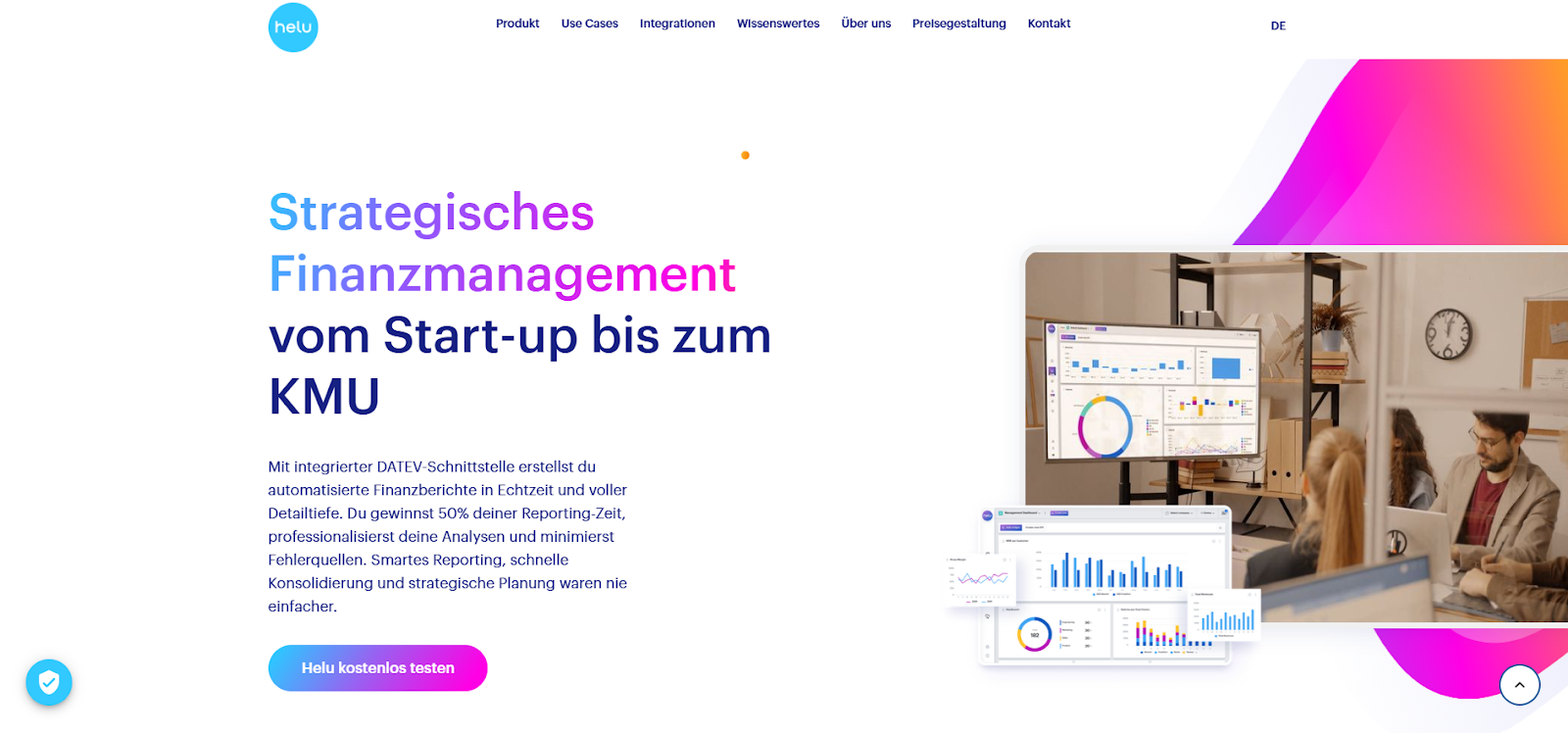
Helu ist ein strategisches FP&A-Tool für CFOs und Finanzleiter in KMUs und Scale-ups, die das Finanzwesen von einem operativen Engpass in eine aktive Steuerungsfunktion umwandeln wollen. Anders als Tidely oder Commitly ist Helu kein Liquiditätsmanagement-Tool, sondern eine Ergänzung dazu: Helu überbrückt die Lücke zwischen DATEV, operativen Systemen wie HR und CRM und dem Management, sodass Finanzdaten tatsächlich für Entscheidungen genutzt werden können.
Vorteile von Helu:
- DATEV-Integration und automatisiertes Reporting.
Helu ist offizieller DATEV-Marktplatz-Schnittstellenpartner. Buchhaltungsdaten werden automatisch synchronisiert, Reports nach jedem Upload aktualisiert. GuV, Bilanz, Cashflow-Analysen und Kostenstellen-Auswertungen sind ohne manuelle Datenpflege verfügbar. - Strategisches Controlling statt rückwärtsgewandtem Reporting.
Finanzteams können finanzielle und nicht-finanzielle Treiber in einem Modell zusammenführen, eigene KPIs auf Basis der tatsächlichen Unternehmensabläufe definieren und Planungsszenarien simulieren. Teams erhalten eine einzige, kollaborative Quelle der Wahrheit für Planung, Prognose und Steuerung, ohne Versionschaos durch Excel-Dateien. - Eigene KPIs auf Basis realer Unternehmensabläufe.
Helu ermöglicht es Finanzteams, finanzielle und nicht-finanzielle Treiber, etwa aus HR, Vertrieb oder CRM, in einem gemeinsamen Modell zu verknüpfen und daraus eigene KPIs zu erstellen, die sich an den tatsächlichen Abläufen im Unternehmen orientieren.
Nachteile von Helu:
- Kein Echtzeit-Cashflow-Management.
Helu ist nicht für die operative Liquiditätssteuerung gebaut. Wer tagesaktuelle Kontoübersichten und Liquiditätsprognosen benötigt, braucht ergänzend ein spezialisiertes Tool wie Tidely. - Fokus auf strategische Planung, nicht auf operative Finanzverwaltung.
Helu konzentriert sich auf FP&A, Budgetierung und Szenarioplanung. Operative Aufgaben wie Rechnungsfreigaben, Zahlungsverkehr oder Bankanbindung sind nicht Teil des Funktionsumfangs. Unternehmen, die beides in einem Tool suchen, brauchen eine ergänzende Lösung.telle.
Was kostet Helu?
Helu bietet individuelle Preisangebote, basierend auf den spezifischen Anforderungen eines Unternehmens. Interessierte Unternehmen können direkt Kontakt aufnehmen, um ein maßgeschneidertes Angebot zu erhalten.

5. re:cap
⭐️⭐️⭐️⭐️⭐️ 4.7 / 5
30 reviews on OMR
Preis: Ab 0 € / Monat (kostenloses Basispaket), Pro ab 79 € / Monat
Demo: Yes
Free trial: Yes, 14 days
re:cap wurde 2021 gegründet und ist keine klassische Cashflow-Management-Software, sondern ein sogenanntes "Capital OS" — eine Plattform die Liquiditätsanalyse, Forecasting und nicht-verwässernde Fremdfinanzierung in einem Tool vereint. Die Plattform richtet sich primär an Tech- und SaaS-Gründer, die vor oder während einer Finanzierungsrunde stehen und verstehen wollen, wie finanzierbar ihr Unternehmen heute ist.
Vorteile von re:cap:
- Kostenloses Basispaket mit echtem Mehrwert.
Das Essential-Paket ist dauerhaft kostenlos und bietet grundlegende Echtzeit-Cashflow-Analyse, Runway-Tracking und ein Prognoseszenario. Für Frühphasen-Gründer die noch kein Budget für ein Liquiditätstool haben, ist das ein echter Einstiegspunkt. - Liquiditätsmanagement und Finanzierung aus einer Hand.
re:cap zeigt nicht nur den aktuellen Cashflow, sondern direkt auch welche Finanzierungskonditionen ein Unternehmen heute erhalten würde und wie sich das verändert wenn man wartet. Finanzierungsvolumen von 50.000 bis 25 Mio. € sind ohne Anteilsabgabe abrufbar. - Sehr breite Bankanbindung.
re:cap bietet Schnittstellen zu mehr als 14.000 Banken in Europa und Nordamerika, deutlich mehr als die meisten Wettbewerber. Besonders relevant für Startups mit internationalen Bankverbindungen.
Nachteile von re:cap:
- Andere Zielgruppe als klassische KMU-Tools.
re:cap ist für Gründer und Startup-Teams optimiert die Finanzierung im Blick behalten wollen. Für etablierte KMUs ohne Wachstumsfinanzierungsbedarf, die ihren operativen Cashflow professionell steuern wollen, ist z. B. Tidely die passendere Wahl. - Fehlende Buchhaltungsintegrationen.
Mehrere Nutzerreviews auf OMR bemängeln fehlende Schnittstellen zu Buchhaltungssystemen wie DATEV oder Lexoffice.
Wie viel kostet re:cap?
Das Essential-Paket ist laut Anbieter dauerhaft kostenlos. Das Pro-Paket startet ab 79 € pro Monat und bietet unbegrenzte Szenarien, detaillierte Transaktionsanalyse und persönliches Onboarding. Die Preise staffeln sich je nach Jahresumsatz des Unternehmens.

6. fygr
⭐️⭐️⭐️⭐️⭐️ 4.8 / 5
5 Bewertungen bei Capterra
Preis: Ab 69,00 €/ Monat
Demo: No
Kostenloser Testzugang: Ja, 7 Tage
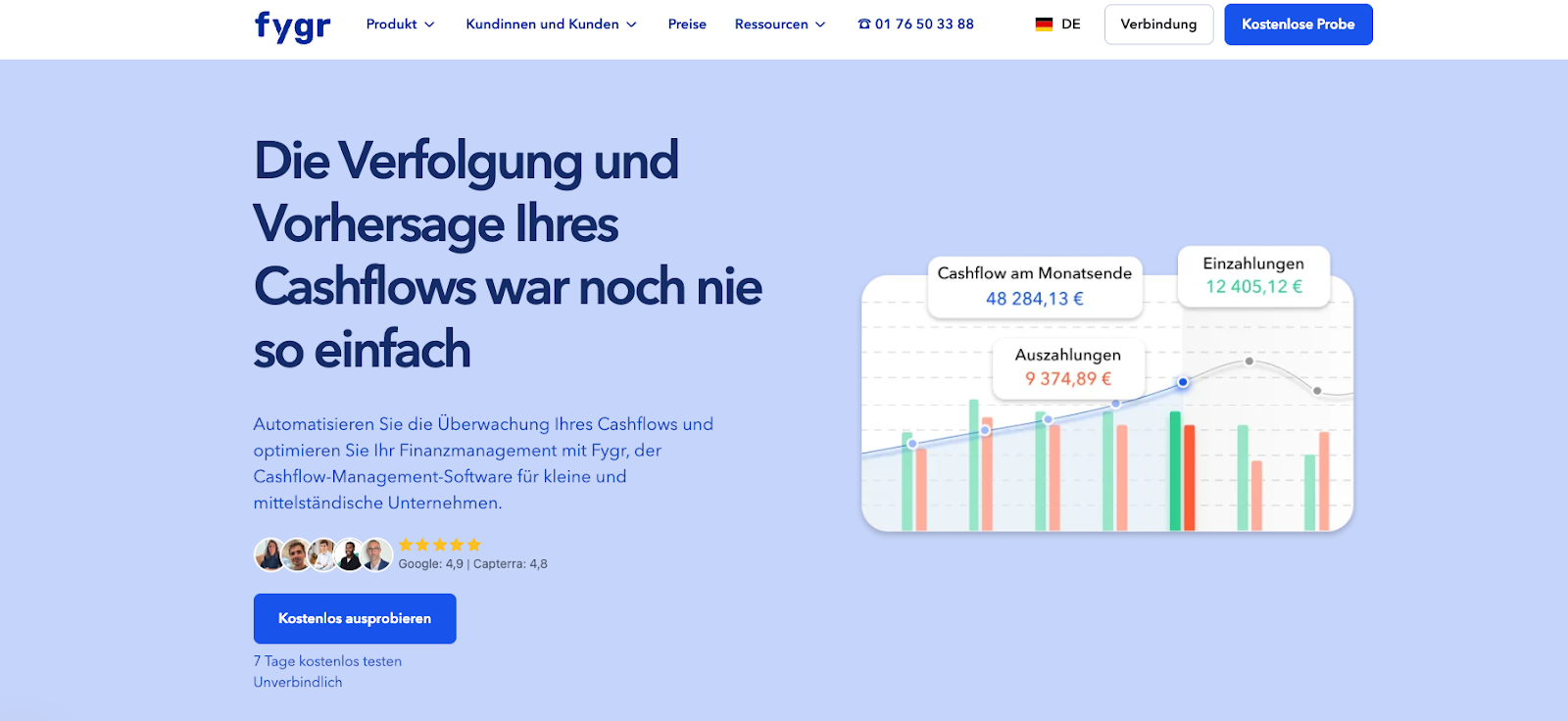
fygr ist eine französische Cashflow-Management-Software für KMUs und Kleinstunternehmen mit bis zu 5 Mio. € Jahresumsatz. Die Plattform setzt auf einfache Bedienung, KI-gestützte Prognosen und dynamische Szenarioplanung, ohne den Funktionsumfang komplexerer Enterprise-Tools.
Vorteile von fygr:
- KI-gestützte Prognosen und Szenarioplanung.
fygr bietet KI-basierte Cashflow-Prognosen, erweiterte Formeln und je nach Paket bis zu unbegrenzte Szenarien mit Tages- und Wochenansichten. Veränderungen im Cashflow lassen sich damit schnell simulieren und bewerten. - Multi-Währungen und ERP-Integration.
Ab dem Pro-Paket unterstützt fygr mehrere Währungen und die Integration von Management-Tools und ERP-Systemen über API. Das Unternehmenspaket ergänzt dies um Multi-Entity-Konsolidierung und SFTP-Anbindung. - Benutzerfreundlich ohne Buchhalter-Vorkenntnisse.
fygr ist bewusst einfach gehalten und richtet sich auch an Gründer und Geschäftsführer ohne Finanz-Hintergrund.
Nachteile von fygr:
- ERP-Integration erst ab Pro-Paket.
Im Starter-Paket (bis 2 Mio. € Jahresumsatz) ist keine ERP-Anbindung enthalten. Wer tiefe Systemintegration braucht, muss mindestens das Pro-Paket ab 104 € / Monat wählen. - Begrenzter Support und keine persönliche Demo.
Nutzer bemängeln, dass der Support nicht immer schnell oder umfassend reagiert. Eine individuelle Einführung oder persönliche Demo gibt es nicht, was den Einstieg erschweren kann.
Wie viel kostet fygr?
fygr bietet drei Pakete: Starter ab 69 € / Monat (bis 2 Mio. € Jahresumsatz, 2 Banken, 3 Szenarien), Pro ab 104 € / Monat (bis 5 Mio. € Jahresumsatz, 4 Banken, 5 Szenarien), Unternehmen auf Kostenvoranschlag (mehrere Einheiten oder ab 5 Mio. € Jahresumsatz). Alle Pakete beinhalten eine kostenlose Testphase.

7. companyon
⭐️⭐️⭐️⭐️⭐️ 4.9 / 5
7 reviews on OMR
Price: From €69.00/month
Demo: Yes
Free trial: Yes, 14 days
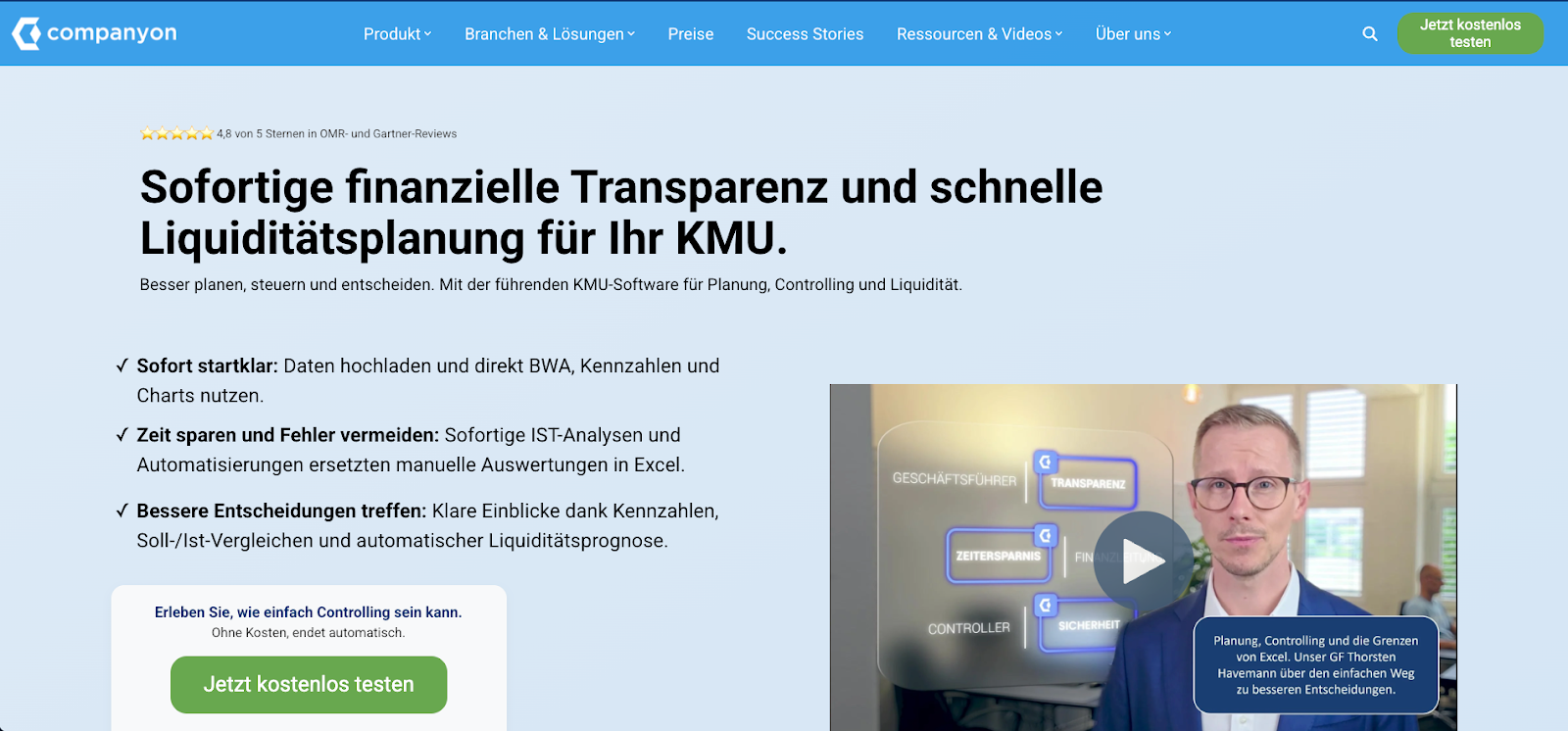
companyon ist eine Controlling-Software für KMUs, die Planung, Budgetierung, BWA, Kennzahlenanalyse und Liquiditätsprognosen in einem Tool vereint. Ähnlich wie Helu liegt der Schwerpunkt auf strategischem Controlling, nicht auf operativer Echtzeit-Liquiditätssteuerung. Die Software ist innerhalb weniger Minuten einsatzbereit. Buchhaltungsdaten werden per Datei-Upload eingebunden, eine direkte DATEV-Schnittstelle gibt es nicht.
Vorteile von companyon:
- Schnelle Implementierung ohne Projektlaufzeit.
companyon ist nach dem Upload der Buchhaltungsdaten sofort startklar. Berichte, BWA und Kennzahlen werden automatisch generiert, ohne manuelle Einrichtung. - Automatische Liquiditätsprognosen aus Ist- und Plandaten.
companyon erstellt aus den vorhandenen Buchhaltungs- und Plandaten automatisch Liquiditätsprognosen sowie Ergebnis- und Cashflow-Forecasts, inklusive Szenarioplanung und Soll-Ist-Vergleichen. - Konsolidierung mehrerer Gesellschaften.
Unternehmen mit mehreren Filialen, Gesellschaften oder Beteiligungen können alle Einheiten mit wenigen Klicks konsolidieren und als Gesamtüberblick auswerten, inklusive konsolidierter Liquiditätsprognose.
Nachteile von companyon:
- Kein Echtzeit-Cashflow auf Bankkonten-Basis.
companyon arbeitet auf Basis von hochgeladenen Buchhaltungsdaten, nicht auf Basis von Live-Bankverbindungen. Wer tagesaktuelle Kontostände und automatische Banksynchronisation benötigt, ist mit Tidely besser bedient. - Keine direkte DATEV-Schnittstelle.
Im Unterschied zu Tools wie Helu gibt es keine automatische DATEV-Anbindung. Daten müssen manuell exportiert und hochgeladen werden.
Wie viel kostet companyon?
companyon offers four packages: Basic from €69/month, Professional from €109/month, Expert from €179/month (all excl. VAT, billed annually), and Premium upon request. A 14-day free trial is available.

8. finban
⭐️⭐️⭐️⭐️⭐️ 4.8 / 5
17 reviews on OMR
Price: From €26.25/month
Demo: Yes
Free trial: Yes, 14 days
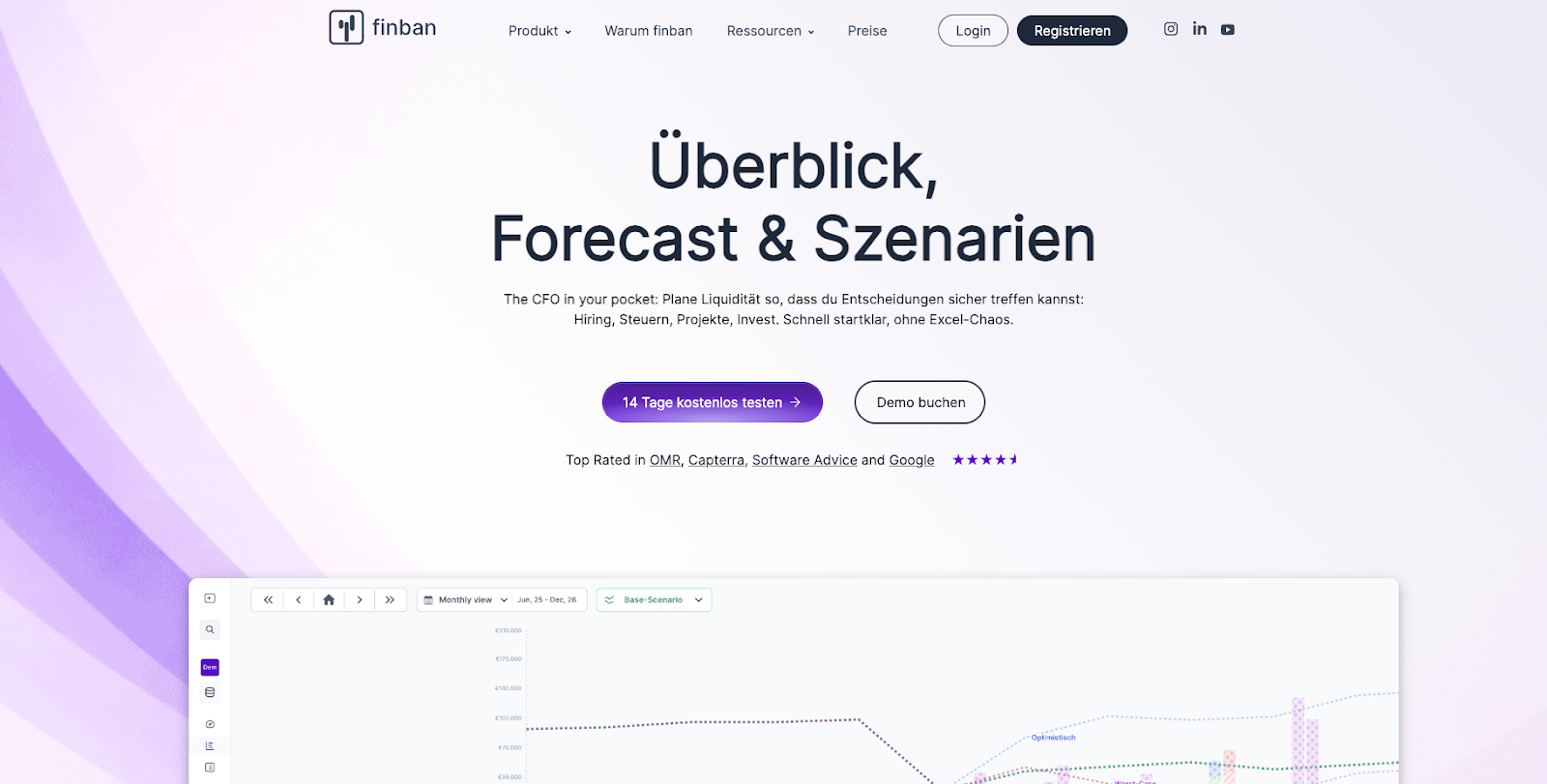
finban wurde 2023 gegründet und ist eine moderne Finanzplanungssoftware, die speziell für KMUs, Start-ups, Agenturen und SaaS-Unternehmen entwickelt wurde. Sie bietet Funktionen wie Echtzeit-Cashflow-Prognosen, Szenario-Planung und Integration von Bankkonten und Buchhaltungstools, wodurch finban eine echte Alternative zu herkömmlichen Excel-Tabellen darstellt.
Vorteile von finban:
- Günstigster Einstiegspreis im Vergleich.
Mit 26,25 € / Monat im Starter-Paket ist finban das günstigste spezialisierte Cashflow-Tool in dieser Liste. Für Solos und Kleinstunternehmen mit einem Bankkonto und einer Buchhaltung ein attraktiver Einstieg. - Flexible Szenarioplanung.
finban ermöglicht die Erstellung und den Vergleich verschiedener Finanzszenarien, um Auswirkungen von Investitionen, Neueinstellungen oder Zahlungsausfällen auf die Liquidität direkt zu sehen. - Hohe Datensicherheit.
finban speichert Daten auf AWS-Servern in Europa und erfüllt DSGVO- sowie ISO/IEC 27001:2013-Standards.
Nachteile von finban:
- Keine Auto-Kategorisierung.
Im Unterschied zu Tidely fehlt eine automatische Kategorisierung von Transaktionen sowie Kategorisierungsregeln. Transaktionen müssen manuell zugeordnet werden, was bei wachsender Transaktionszahl zeitaufwendig wird. - Begrenzte ERP-Integration.
finban bietet derzeit nur eingeschränkte Schnittstellen zu gängigen ERP-Systemen, was den automatischen Datenaustausch mit der Buchhaltung erschwert.
Wie viel kostet finban?
finban bietet vier Pakete bei jährlicher Zahlung: Starter ab 26,25 € / Monat (1 Bankkonto, 1 Organisation, 1 Benutzer), Business ab 48,75 € / Monat (5 Bankkonten, 5 Benutzer), Pro ab 90 € / Monat (10 Bankkonten, 5 Organisationen, 10 Benutzer), Custom auf Anfrage für komplexe Unternehmensstrukturen und Family-Offices.

9. Board
⭐️⭐️⭐️⭐️⭐️ 4.7 / 5
30 reviews on OMR
Price: Upon request
Demo: Yes
Free trial: No
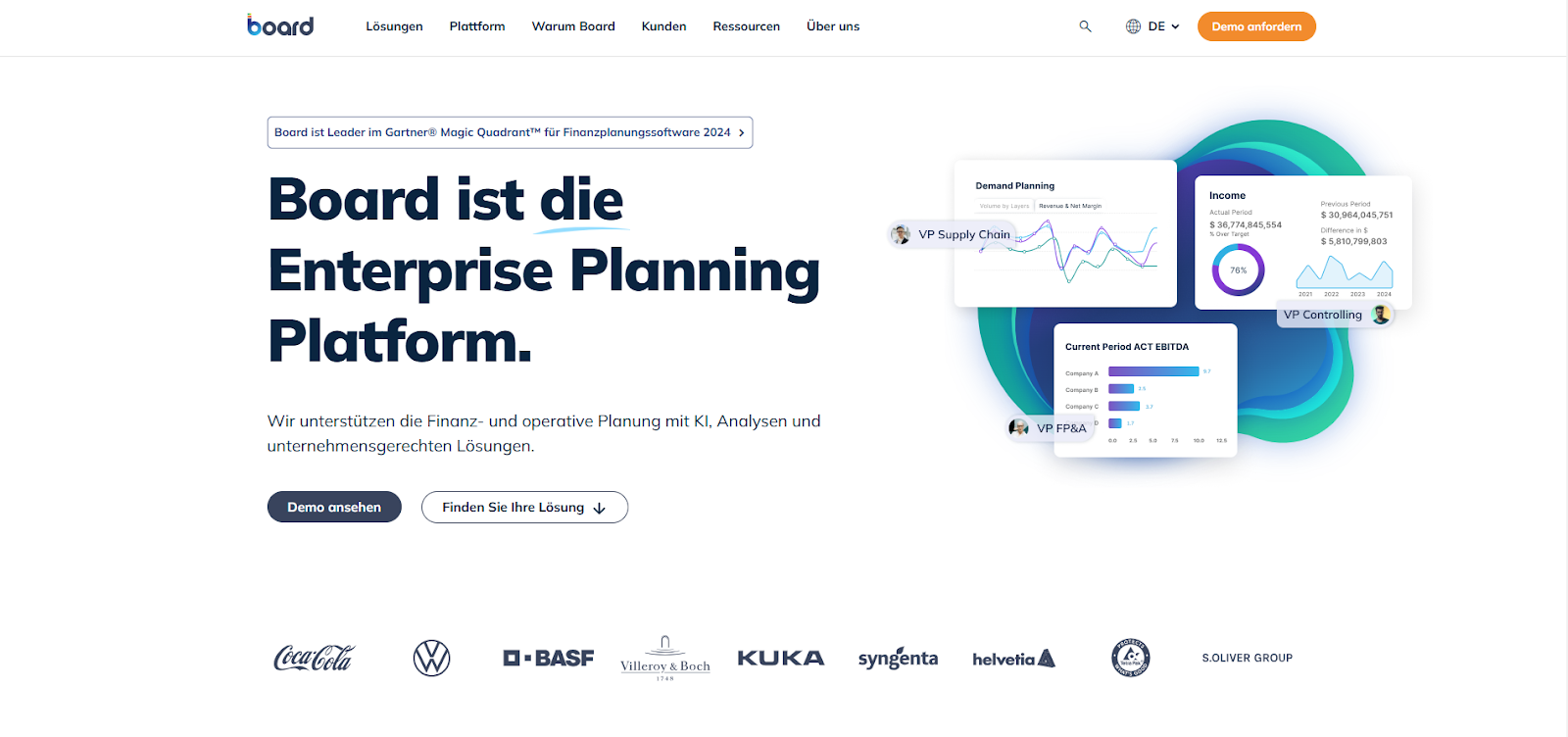
Board ist eine Enterprise Planning Platform aus der Schweiz, die Business Intelligence, Corporate Performance Management und Predictive Analytics in einer einzigen Plattform vereint. Das Tool richtet sich primär an mittlere und große Unternehmen in Branchen wie Handel, Fertigung und Finanzdienstleistungen, die komplexe Planungs- und Analyseprozesse zentralisieren möchten. Cashflow-Management ist dabei eine Teilfunktion innerhalb eines deutlich breiteren FP&A-Rahmens.
Vorteile von Board:
- Alles in einer Plattform.
Board kombiniert Reporting, Dashboards, Szenario-Simulation, Forecasting und Planung ohne den Einsatz mehrerer separater Tools. Für Unternehmen mit komplexen Strukturen entfällt damit der Aufwand für die Datensynchronisation zwischen verschiedenen Systemen. - Breite Datenintegration.
Die Plattform verbindet sich mit SAP, Salesforce, Microsoft und weiteren ERP- und CRM-Systemen und schafft damit eine konsolidierte Datenbasis als Single Source of Truth.
Nachteile von Board:
- Steile Lernkurve und Implementierungsaufwand.
Nutzer berichten, dass die initiale Konfiguration komplex ist und in der Regel externe Consultants erfordert. Für KMUs ohne dediziertes IT- oder Controlling-Team ist der Einstieg aufwendig. - Kein operatives Echtzeit-Cashflow-Management.
Board ist eine strategische Analyse- und Planungsplattform, keine Liquiditätssteuerungslösung. Für tagesaktuelle Cashflow-Übersichten auf Bankkonten-Basis, automatische Bankanbindung und operative Liquiditätsplanung ist Tidely die passendere Wahl.
Wie viel kostet Board?
Die Preise sind nicht öffentlich einsehbar und werden individuell vereinbart. Da Board primär auf mittlere bis große Unternehmen ausgerichtet ist, ist die Kostenstruktur für kleinere Betriebe in der Regel nicht wirtschaftlich.

10. finway
⭐️⭐️⭐️⭐️⭐️ 4,4 / 5
58 Bewertungen bei OMR
Preis: Ab 209,00 €/ Monat
Demo: Yes
Free trial: Yes, 14 days
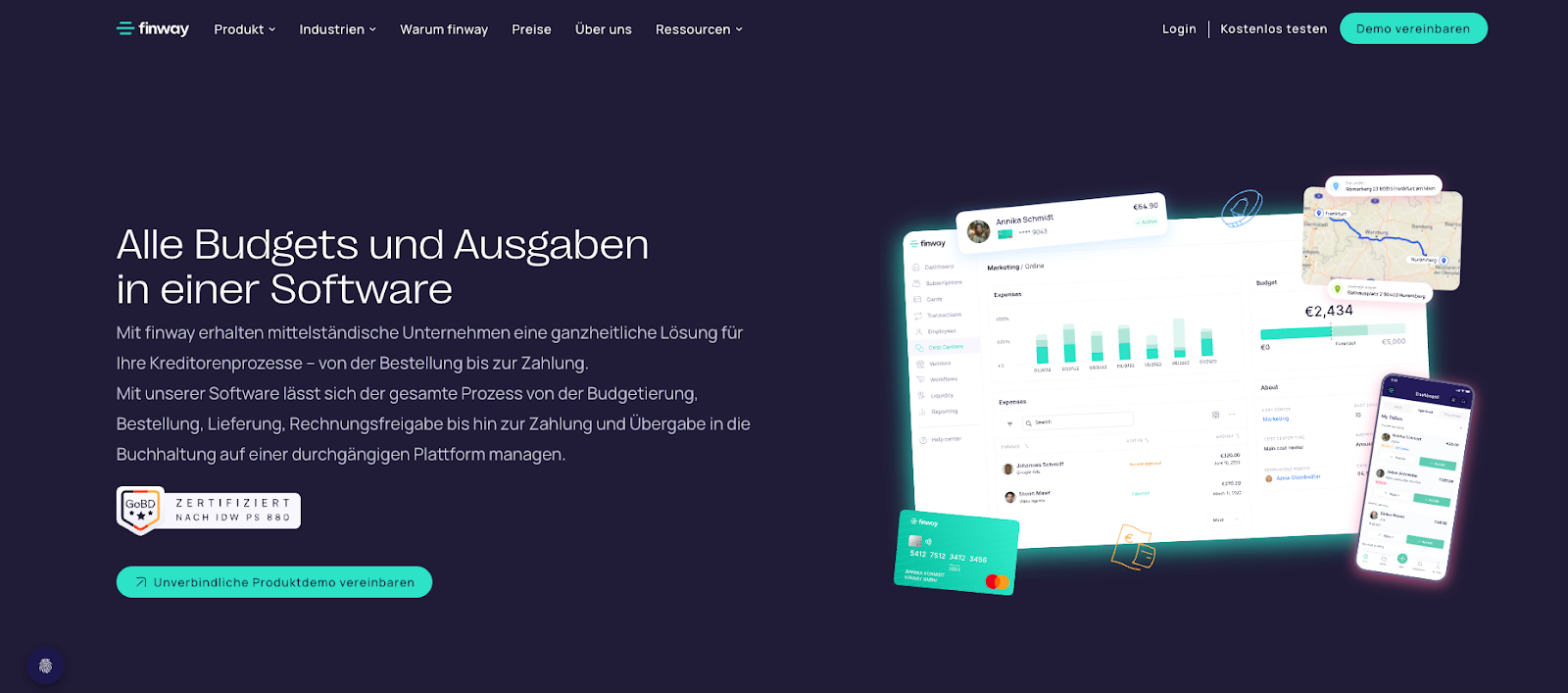
finway wurde 2020 gegründet und ist eine Ausgabenmanagement-Plattform für KMUs, die Rechnungsverarbeitung, Freigabeprozesse, Bankanbindung, virtuelle und physische Karten sowie DATEV-Export in einem Tool vereint. Der Fokus liegt nicht auf Cashflow- und Liquiditätsplanung, sondern auf der Automatisierung operativer Finanzprozesse. finway eignet sich daher als Ergänzung zu einer dedizierten Cashflow-Lösung wie Tidely, nicht als Ersatz.
Vorteile von finway:
- Starke DATEV-Integration.
finway bietet eine direkte DATEV-Schnittstelle inklusive Vorkontierung und Rechnungssplit, was die Übergabe an den Steuerberater deutlich vereinfacht. - Unbegrenzte Nutzer in allen Paketen.
Der Preis richtet sich nicht nach der Nutzeranzahl, sondern nach der Anzahl der monatlich verarbeiteten Eingangsrechnungen. Das macht finway für Teams mit vielen Mitarbeitern kalkulierbar. - Schneller Support.
Nutzer auf OMR loben den reaktionsschnellen und kompetenten Kundenservice als einen der Hauptvorteile.
Nachteile von finway:
- Kein Cashflow-Management.
finway bildet keine Liquiditätsplanung, keine Szenarioplanung und keine Cashflow-Prognosen ab. Unternehmen, die Echtzeit-Überblick über ihre Liquidität benötigen, brauchen ein ergänzendes Tool wie Tidely. - Hoher Einstiegspreis für KMUs.
Mit 209 € / Monat im Essential-Paket ist finway das teuerste Tool in diesem Vergleich. Für kleine Unternehmen mit wenigen Eingangsrechnungen ist das Preis-Leistungs-Verhältnis kritisch zu prüfen.
Wie viel kostet finway?
finway bietet zwei Pakete: Essential ab 209 € / Monat und Professional ab 299 € / Monat. In beiden Paketen sind unbegrenzte Nutzer enthalten. Der Preis steigt mit der Anzahl der monatlich verarbeiteten Eingangsrechnungen, wobei 100 Rechnungen im Basispreis enthalten sind.
3 Tipps: So findest Du das passende Cashflow-Management-Tool
Die Wahl der richtigen Cashflow-Management-Software hängt davon ab, welche Anforderungen Du an das Tool selbst hast und welche Leistungen Dein Unternehmen braucht. Diese drei Kriterien helfen Dir, die Entscheidung zu strukturieren.
1. Definiere, wofür genau Du dieses Tool braucht
Wenn Du eine Software suchst, die sich speziell auf die Steuerung Deines Cashflows konzentriert, solltest Du Tools wie Tidely, Agicap oder Commitly in Betracht ziehen. Diese Lösungen wurden gezielt für Liquiditätsmanagement, Szenarioplanung und Echtzeit-Überblick über Deine Zahlungsströme entwickelt. Sie helfen Dir, finanzielle Engpässe frühzeitig zu erkennen und Deine Liquidität aktiv zu steuern.
Falls Du neben der Cashflow-Planung auch strategisches Controlling, FP&A oder Budgetierung benötigst, sind Tools wie Helu oder companyon sinnvolle Ergänzungen. Für operative Finanzprozesse wie digitale Rechnungsverarbeitung und Ausgabenmanagement bietet sich finway an.
Wichtig: Diese Tools ersetzen keine dedizierte Cashflow-Software, sondern ergänzen sie.
2. Berücksichtige die Größe Deines Unternehmens
Je nach Unternehmensgröße variieren die Anforderungen an eine Cashflow-Software erheblich. Tidely ist besonders für KMUs, Start-ups und Scale-ups geeignet, da es eine schnelle Implementierung, intuitive Bedienung und ein transparentes Preis-Leistungs-Verhältnis bietet, bereits ab 45 € / Monat inklusive KI-Kategorisierung und KI-Cashflow-Prognose.
For companies that also require advanced features like cash pooling, dunning, or BI and performance management, Board or Agicap may be an alternative. However, you should also expect significantly higher costs and a longer implementation process here.
3. Prioritize support and personal consulting
Good support is crucial, especially during setup. Make sure the provider offers comprehensive consulting and support options. This is exactly where Tidely is a strong alternative to Commitly: Tidely offers personal live onboarding, support via email, chat, and phone, as well as a personal consultant in the Enterprise package. This is complemented by video tutorials and an extensive knowledge base.
Conclusion: Which cash flow software is right for you?
The 10 tools in this comparison are aimed at very different target groups. Here are the most important recommendations at a glance:
Tidely is the best choice for SMEs, start-ups, scale-ups, and project-based companies looking for specialized cash flow management software with fast implementation, transparent pricing, and personal support. AI categorization and AI cash flow forecasting are included in the Starter package starting at €45/month.
Agicap is suitable for medium-sized companies and corporations with complex multi-entity structures and a dedicated finance team that are prepared to pay a significantly higher price.
Commitly is a solid alternative to Tidely for the DACH region, but it offers fewer accounting integrations and no personal onboarding.
Helu and companyon are useful additions for companies that need strategic controlling and FP&A alongside their cash flow solution, but they are not a replacement for operational liquidity planning.
re:cap is aimed specifically at tech and SaaS founders looking for liquidity analysis and debt financing from a single source.
finban is the most affordable specialized solution in this comparison and is ideal for solo entrepreneurs and micro-enterprises with simple structures.
Board and finway are specialized tools for BI/enterprise planning and expense management, respectively, and are not direct alternatives to cash flow software.
If you are looking for a user-friendly, transparent, and affordable solution for your cash flow management and liquidity planning, Tidely is the right choice. Unlike many competitors, we place great importance on ensuring you are not left on your own: personal onboarding, intuitive usability, and a focus on essential functions make Tidely the ideal solution for SMEs and growing companies.
Try Tidely for 7 days for free and benefit from simpler, more transparent, and more efficient financial management.
Note: As our industry evolves rapidly, provider details and prices can change very quickly. If you notice an error, please feel free to contact us and let us know. We will then correct it.
FAQ
What does Tidely do?
Tidely is a cash flow management software specifically designed for SMEs, start-ups, and scale-ups. It offers real-time liquidity monitoring, enables scenario analysis and AI-based cash flow forecasting, and integrates with bank accounts and accounting systems. The goal is to provide companies with transparent and automated financial planning so they can grow with confidence.
Which cash flow software is right for SMEs?
Which cash flow tool is best for SMEs depends on individual requirements. Tidely is ideal for companies looking for a user-friendly, transparent solution with a quick start. Commitly offers specialized liquidity planning for the DACH region, but with fewer integrations and no personal onboarding.
Agicap is suitable for larger companies with complex multi-entity structures and more budget. For very simple structures with one bank account, finban is the most affordable specialized option.
Ist Tidely eine Agicap Alternative?
Ja, Tidely ist eine starke Agicap-Alternative für KMU und Scale-ups. Beide Tools bieten Cashflow-Management und Szenarioplanung. Der Unterschied liegt im Preis und der Zielgruppe: Agicap richtet sich mit seinem breiteren Funktionsspektrum primär an mittelständische Unternehmensgruppen mit dediziertem Finanzteam. Tidely ist transparenter in der Preisgestaltung, schneller in der Implementierung und bietet ein persönliches Onboarding.
Ist Tidely eine Commitly Alternative?
Ja, Tidely kann als Alternative zu Commitly gesehen werden. Beide Lösungen sind auf Cashflow-Management spezialisiert und bieten Echtzeit-Daten sowie Forecasting-Funktionen. Der Unterschied: Tidely bietet mehr Buchhaltungsintegrationen, persönliches Onboarding und über 5.000 Bankverbindungen. Für Unternehmen, die neben der Cash Flow Planung auch Support und Beratung wünschen, ist Tidely die stärkere Wahl.
Was ist der Unterschied zwischen Cashflow Software und Buchhaltungssoftware?
Buchhaltungssoftware dokumentiert vergangene Transaktionen und erstellt Jahresabschlüsse. Cash Flow Software blickt in die Zukunft: Sie hilft Dir, Liquiditätsengpässe frühzeitig zu erkennen, Szenarien zu modellieren und Deine Zahlungsströme aktiv zu steuern. Viele Unternehmen nutzen beide Tools parallel, da sie sich ergänzen statt ersetzen. Tidely integriert sich direkt mit gängigen Buchhaltungstools.
Welche ist die beste Cashflow-Management-Software?
Welches das beste Cash Flow Tool ist, hängt von den Anforderungen Deines Unternehmens ab. Für KMUs und Scale-ups, die ein transparentes Cash Flow Software mit schneller Implementierung suchen, ist Tidely die beste Wahl. Für größere Unternehmen mit komplexen Strukturen bietet Agicap mehr Tiefe. Wer primär strategisches Controlling und FP&A benötigt, ist mit Helu oder companyon besser beraten.
Gibt es kostenlose Cashflow-Softwares?
Ja, es gibt kostenlose Tools und Excel-Vorlagen, die sich für einfache Cashflow Planungen eignen. Allerdings stoßen diese schnell an ihre Grenzen: Excel liefert keine Echtzeit-Liquiditätsdaten, jede Tabelle muss manuell aktualisiert werden, was fehleranfällig und zeitaufwendig ist. Tidely ist 7 Tage kostenlos testbar, ohne Kreditkarte.
Wie lange dauert die Einrichtung einer Cashflow-Software?
Das hängt stark vom Tool ab. Tidely ist darauf ausgelegt, dass Du in unter 15 Minuten startklar bist: Bankkonten verbinden, Buchhaltungssystem integrieren, erste Cashflow-Prognose abrufen. Enterprise-Lösungen wie Board oder Agicap erfordern dagegen häufig mehrwöchige Implementierungsprojekte mit externen Consultants.


