Cash Flow: Definition, Meaning & Types Explained Simply
Cash flow is one of the most honest financial indicators in your business. It determines whether you can pay bills, invest and grow. Well-managed cash flow is more than a safety net. It is a lever for growth: when you understand your payment flows, you can invest at the right time, use early-payment discounts, negotiate better terms and seize opportunities before competitors react. The stakes are high: in 2025, around 82% of business insolvencies in Germany affected micro-enterprises (Creditreform, 2025). For startups, running out of capital is also one of the most common reasons for failure: according to CB Insights, lack of capital played a role in 70% of the startup shutdowns examined since 2023 (CB Insights, 2026). In this guide, you’ll learn how to use your cash flow for stability, flexibility and growth.
.png)
Key takeaways
What is cash flow? Definition:
Cash flow refers to the difference between all of a company's cash inflows and outflows during a specific period, such as a month, quarter, or year. It measures the actual flow of funds and shows how much liquid capital a company generates on its own.
Cash flow is a flow variable. It looks at the movement of money over time, independent of purely accounting-based processes like depreciation. This is exactly what makes it so insightful. It shows how effectively your company manages its financial resources. In short, cash flow answers the question of whether there is more money at the end of a period than there was at the beginning.
Cash flow explained simply: the bank account analogy
Think of your company like a bank account: money comes in, for example through customer payments or loan disbursements, and money goes out, such as for wages, rent, suppliers, or taxes.
Cash flow shows whether more money flowed in or out during a specific period.
If more money came in than went out, the cash flow is positive. If more money flowed out than in, it is negative. It is important to note that customer payments are part of day-to-day operations, while loans are part of financing. Together, they show how your cash balance changes over the period.
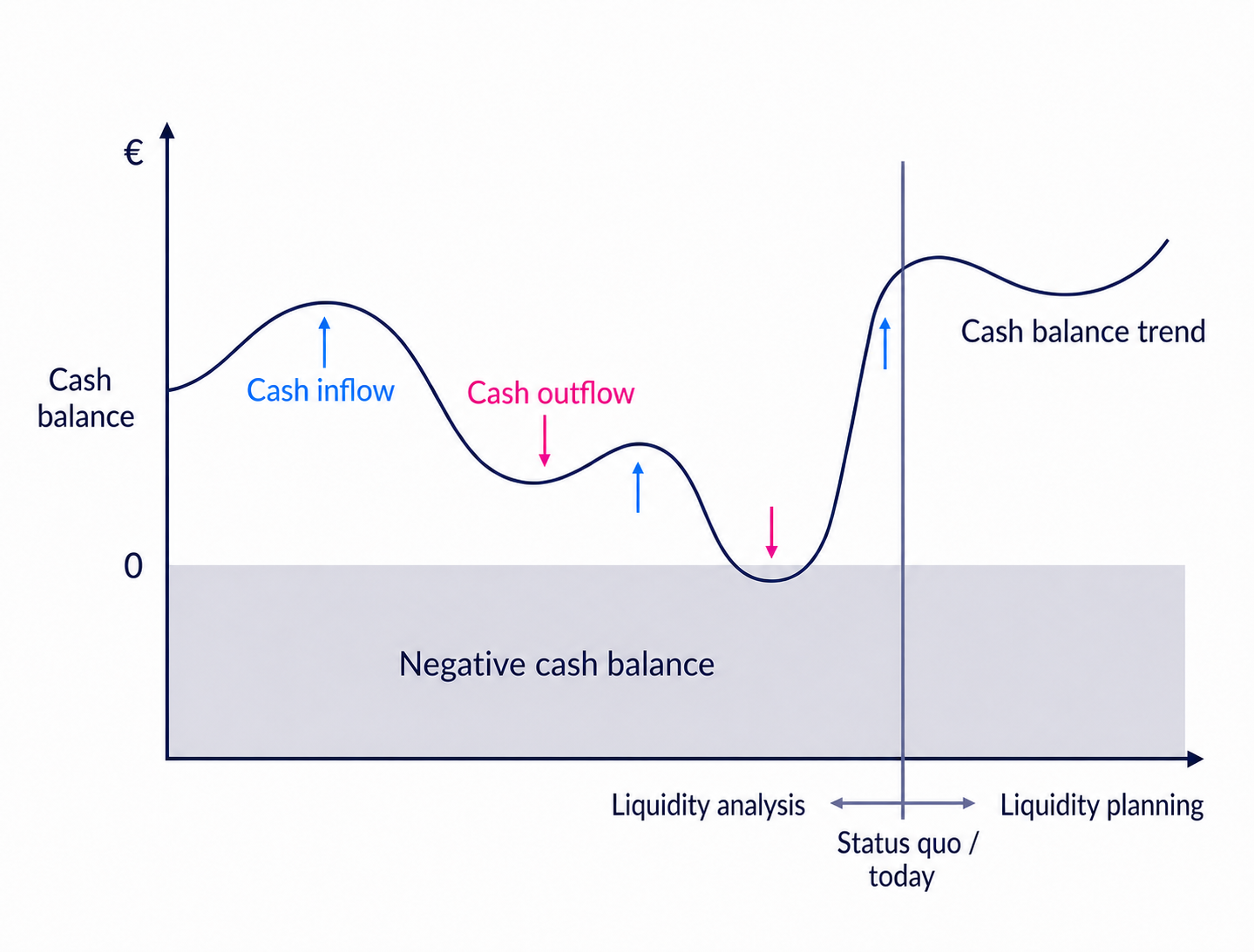
Cash flow changes your cash balance over time: incoming payments increase liquidity, while outgoing payments decrease it. On the left, liquidity analysis shows the past, while on the right, liquidity planning looks ahead.
What is the difference between cash flow, profit, and liquidity?
These three terms are often confused, but they mean different things.
In short: Profit is accounting, cash flow is movement, and liquidity is a point in time.
Important: A company can show a profit and still run into payment difficulties if the money has not yet been received. Therefore, cash flow is not the same as profit, and liquidity shows whether you can pay your bills right now.
We explore how solvency and cash flow interact in more detail in our guide to liquidity planning.
If you want to determine your solvency in concrete terms, our article Calculating liquidity will help you step by step.
Why is cash flow so important?
Cash flow is important because it reveals financial bottlenecks earlier than many other metrics. Payment problems often arise not because a company is unprofitable, but because money comes in too late, costs are due earlier, or liquidity has not been planned sufficiently.
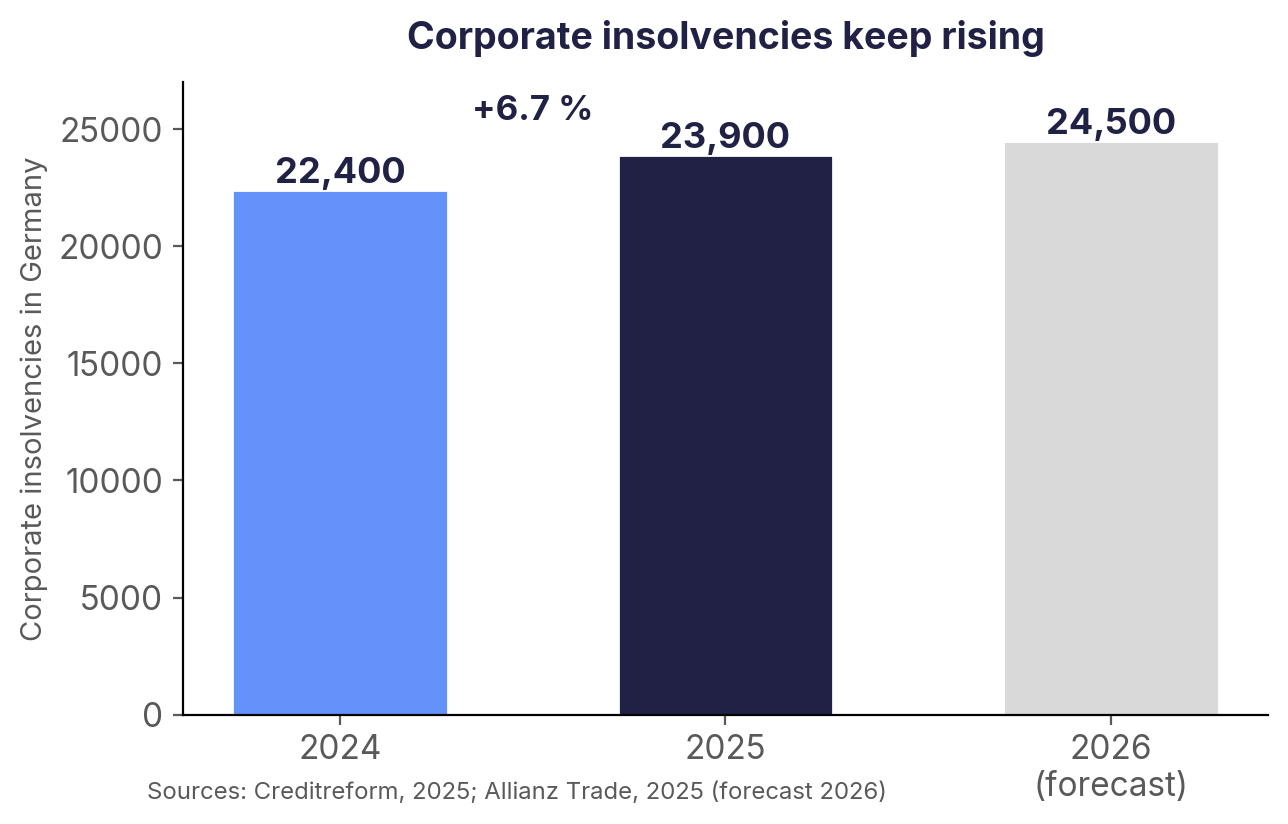
The trend in corporate insolvencies in Germany shows just how great this risk is: in 2025, the number of cases rose to around 23,900, an increase of 6.7% compared to the previous year (Creditreform, 2025). For 2026, approximately 24,500 insolvencies are expected (Allianz Trade, 2025). Especially in a tense market environment, cash flow is becoming a key management metric.
Cash flow is not just a protective shield, but also a management tool. If you know your cash flow, you can identify bottlenecks early enough to take corrective action. At the same time, cash flow shows you when there is room for investments, taking advantage of early payment discounts, debt repayment, or growth.
The same metric that warns you of risks also shows you when the time is right for your next business move.
As a standardized metric that is difficult to manipulate, cash flow creates transparency for management, investors, and lenders. Above all, it makes three things visible:
- Financial stability: whether your company is generating enough money on its own to cover ongoing costs.
- Operational flexibility: how much money is available for investments, debt repayment, or distributions.
- Early warning system: whether financial risks are emerging long before they turn into actual payment problems.
Why do so many companies fail because of cash flow?
Because revenue does not equal cash in the bank. A company can have full order books and still run into trouble if invoices are paid late, while wages, rent, suppliers, and taxes are due immediately. The problem is therefore often not a lack of revenue, but a timing issue between service delivery, invoicing, and payment receipt.
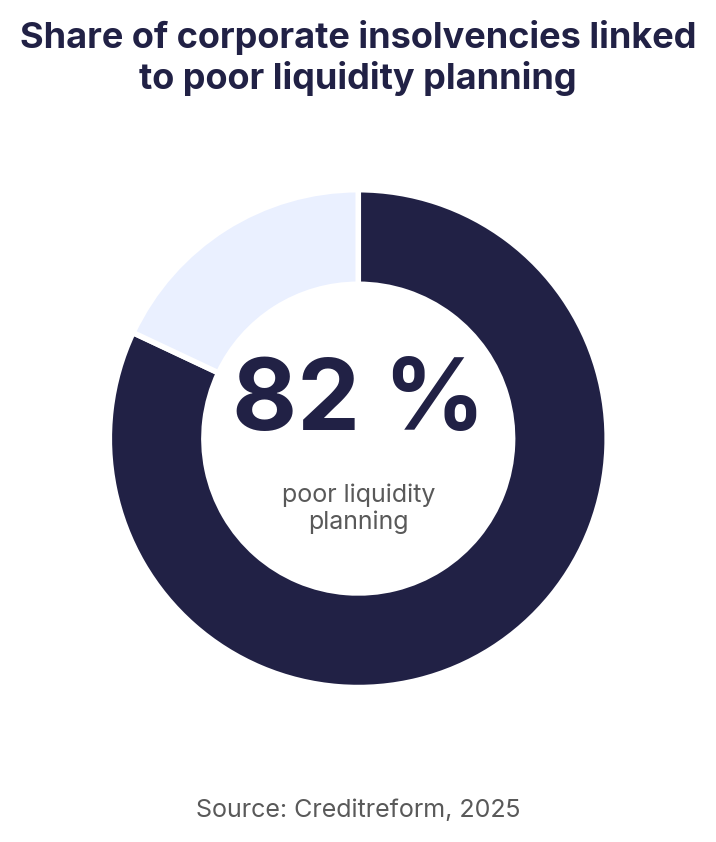
Smaller companies are particularly affected by this because their reserves are often limited and delayed payments lead to bottlenecks more quickly. According to Creditreform, in 2025, approximately 82% of corporate insolvencies were micro-enterprises. At the same time, 2019 QuickBooks data shows that 69% of small business owners lie awake at night worrying about cash flow. This highlights how heavily cash flow issues weigh on small businesses in their day-to-day operations.
The reason is usually simple: costs are ongoing, while customer payments arrive later. Even profitable companies can find themselves in distress if they lack reserves and planning. That is why cash flow is not just a financial topic, but a leadership responsibilityActively managing the gap between service delivery and payment receipt ensures you remain agile, even during challenging times.
Why is cash flow so critical right now?
In short: Because payment behavior remains strained, and money often arrives later than companies need it for their ongoing expenses.
According to Intrum, European companies are waiting on trillions in outstanding receivables; in the B2B sector in 2024, invoices were paid an average of 16 days later than agreed in Europe (Intrum, 2024).
QuickBooks also highlights the heavy burden that late or outstanding invoices place on smaller businesses: 56% of US small businesses surveyed had money tied up in unpaid invoices, averaging $17,500 per company (QuickBooks, 2025).
Allianz Trade also reports that global Days Sales Outstanding rose to 59 days in 2023, and longer payment terms can put further pressure on cash flow (Allianz Trade, 2024).
For you, this means: There is often a gap of a month or more between delivering a service and receiving payment. Your cash flow must bridge exactly this gap.
The longer the payment terms are and the more irregular customer payments become, the more important proactive planning becomes. Otherwise, a late payment can quickly turn into a genuine bottleneck, even if the business itself is healthy.

What types of cash flow are there?
In a cash flow statement, cash flow is usually divided into three areas: operating cash flow (OCF), cash flow from investing activities (ICF), and cash flow from financing activities (CFF). Additionally, free cash flow (FCF) is often considered. It is not a separate category in the cash flow statement, but rather a derived metric that shows how much money remains freely available after ongoing operations and investments.
Operating Cash Flow (OCF)
The operating cash flow, also known as cash flow from operations, includes all regular inflows and outflows from core business activities: revenue from sales minus operating expenses such as salaries, rent, and taxes. A positive OCF is the most important sign of operational strength, as it shows the company is self-sustaining. It is usually the first metric banks and investors look at.
Cash Flow from Investing Activities (ICF)
The Investing cash flow reflects cash flows from the purchase or sale of fixed assets, such as machinery, buildings, or investments. A negative ICF is normal during growth phases and is often a positive sign, as the company is investing in its future. Conversely, a positive ICF resulting from asset sales may indicate consolidation.
Cash flow from financing activities (CFF)
The financing cash flow (CFF) relates to the capital structure: inflows from raising equity or debt (stocks, bonds, loans) and outflows for dividends or loan repayments. A positive CFF means that capital is being raised. A negative CFF means that capital is flowing back to owners or creditors.
Free cash flow (FCF)
The free cash flow shows how much money remains after covering ongoing business operations and necessary investments. Simply put, it is calculated as operating cash flow minus capital expenditures. It is a key indicator of financial flexibility, as it shows how much cash is available to pay down debt, pay dividends, or reinvest.
A stable or growing FCF is considered a sign of sound corporate management.
In addition to the classification by activity, cash flow is also distinguished between gross and net, i.e., before and after taxes:
Gross and net cash flow
The gross cash flow corresponds to operating cash flow before taxes. If you subtract the taxes actually paid, you get the net cash flow, which is the cash flow that is actually available to the company after taxes.
The three cash flow areas plus free cash flow at a glance
What is the difference between positive and negative cash flow?
A positive cash flow means that more money is coming in than going out over a given period. A negative cash flow means that more money is going out than coming in. The key factor here is not just the sign, but the cause: a positive operating cash flow usually indicates financial strength, whereas a positive cash flow from new loans must be evaluated differently.
Positive cash flow: Opportunities and benefits
A positive cash flow, especially from day-to-day operations, is a key indicator of financial health. It allows you to cover costs, pay off debt, build reserves, and finance investments. A strong operating cash flow also increases your company's value and makes you more attractive to investors, for example during loan negotiations or funding rounds. It also gives you bargaining power, as you can take advantage of early payment discounts and secure better terms.
Negative cash flow: Risks and disadvantages
A negative cash flow means that more money is flowing out than in. In the short term, this can be normal, such as during major investment phases, when building up inventory, or during growth phases with high upfront costs. However, if this state persists and is not planned for, the risk of insolvency and dependence on external financing increases. It is therefore crucial to plan for a negative cash flow consciously rather than only noticing it when liquidity becomes tight.
How can a company have a positive cash flow despite making a loss?
This is possible because non-cash items such as depreciation reduce accounting profit but do not cause an actual outflow of cash. Payments received from receivables from previous periods or new financing can also ensure that money flows in, even if the profit and loss statement shows a loss. A company can therefore report a loss and still remain liquid. This is precisely why cash flow is often more informative than profit.
What does cash flow tell you about your company?
Cash flow reveals how truly sustainable your business model is.
It answers the question of whether your company generates enough money on its own to cover operating costs, service debt, and grow. This is precisely why operating cash flow is a key metric for management, banks, investors, and rating agencies.
The trend over time is what matters, not a snapshot. A single negative month is rarely a problem. However, an operating cash flow that declines over several periods is a clear warning sign. Furthermore, cash flow only becomes truly meaningful when viewed in the context of different areas and metrics: a negative investment cash flow combined with a strong operating cash flow can indicate healthy growth, whereas a positive cash flow derived primarily from new loans warrants caution.
The most common mistakes in cash flow management
In practice, bottlenecks rarely appear out of nowhere. They are usually caused by avoidable mistakes: confusing revenue with liquidity, being overly optimistic about incoming payments, ignoring seasonal fluctuations, and lacking a rolling forecast. Knowing these pitfalls allows you to take corrective action early.
- Equating revenue with cash flow: A full order book does not mean there is money in the account as long as invoices remain unpaid.
- Planning only in retrospect: Relying solely on past figures means you only spot bottlenecks once they have already arrived.
- Underestimating reserves: Without a liquidity buffer, every late payment immediately becomes a risk.
How do you calculate cash flow? With an example
Cash flow can be determined in two ways: using the direct method or the indirect method. The direct method compares actual cash inflows and outflows. With the indirect method, you start with the net income and adjust it for non-cash items and changes in working capital.
In simple terms:
Cash flow = cash inflows minus cash outflows
For the indirect method, the simplified formula is:
Operating cash flow = net income + depreciation +/- changes in working capital
Calculating cash flow: a brief example
A company has a net result of €150,000, depreciation of €50,000 and an increase in receivables of €20,000. The increase in receivables ties up cash because revenue has already been recorded, but the money has not yet been received. Therefore, it is deducted.
The operating cash flow is therefore: €150,000 + €50,000 - €20,000 = €180,000. Depreciation is added back because it reduces profit but does not result in an actual cash outflow. This example shows why cash flow and profit can diverge.
We show you step-by-step which method is useful when, which formulas apply to operating and free cash flow, and how to follow everything with further calculation examples in our detailed guide: Calculating Cash Flow: Formulas, Methods & Examples.
Which cash flow metrics are important?
Once the cash flow has been determined, metrics help to classify it and assess financial health. Particularly relevant are:
- Cash flow margin: Operating cash flow in relation to revenue. It shows how much of every euro of revenue actually reaches the company as cash flow. A rising margin is a strong sign of operational efficiency.
- Free cash flow (FCF): Operating cash flow after deducting investments. It shows how much money is actually available for debt repayment, distributions, reserves, or growth.
- Price-to-cash-flow ratio (P/CF): Share price divided by cash flow per share. This metric is primarily relevant for publicly traded companies and helps investors assess a company's valuation.
In addition, the Discounted Cash Flow (DCF) plays an important role in business valuation. It involves discounting expected future cash flows to their present value. Therefore, the DCF is not an operational cash flow metric, but a valuation method.
For context: The average equity ratio among German SMEs was recently 30.7% (KfW SME Panel, 2025). It shows how much of a financial buffer companies have to cushion fluctuations in cash flow. The thinner the capital base, the more important a stable operating cash flow becomes. You can find the exact formulas in our comprehensive guide to cash flow calculation.
How do you actively manage your cash flow?
Knowing your cash flow is one thing; actively managing it is another. With ongoing cash flow planning and regular forecasts , you can identify how your liquidity will develop in the coming weeks early on. Nevertheless, 72% of treasury managers still create their cash flow forecasts manually (PYMNTS, 2022), which is time-consuming and prone to errors.
Particularly valuable are scenario analyses. You can simulate developments from best-case to worst-case scenarios and immediately see the impact of an investment, a drop in sales, or a delayed customer payment. We explain the methodology in our article on scenario planning and forecasting.
Automation is also gaining importance in cash management: according to PYMNTS, 70% of surveyed companies already use at least one AI tool to manage their cash flow (PYMNTS, 2026).
Practical tip for everyday finance: "In practice, many companies underestimate the time lag between invoicing and receiving payment. A rolling 13-week forecast closes exactly this gap and turns gut feeling into a reliable basis for decision-making." A tool like Tidely maps bank accounts and forecasts for this purpose on a daily, automated basis, including a 13-week plan with one click.
How can you improve your cash flow?
You can improve your cash flow using two levers: bringing money in faster and spending it more strategically. The biggest lever is often accounts receivable management, because outstanding invoices tie up liquidity exactly where it is actually needed in the company.
- Actively manage receivables: Shorter payment terms, clear dunning processes, and incentives for early payment reduce the time your money stays with the customer.
- Time your expenses: Choose supplier terms and payment dates so that outflows and inflows align better.
- Reduce inventory and capital commitment: Less capital tied up in inventory frees up liquidity.
- Plan ahead: A rolling cash flow forecast reveals bottlenecks before they arise. This is one of the most effective protective mechanisms against payment problems.
- Use a cash flow management tool: A tool like Tidely consolidates bank accounts, payment flows, and forecasts in one place. This allows you to see more quickly when money is getting tight, which payments are affecting your cash flow, and where you can take corrective action.
These measures work together: by tightening receivables, managing expenses, and planning regularly, you make your cash flow predictable rather than reactive. This reduces the risk of running into a bottleneck, even when your order books are full.
For young companies in particular, it is also worth taking a look at burn rate and cash runway.
Conclusion: Understand, plan, and manage your cash flow
Cash flow is the most honest metric for your business. It shows how much money is actually flowing, not just the profit on paper. By understanding the three areas of cash flow, interpreting free cash flow, distinguishing between positive and negative cash flow, and actively planning your cash movements, you lay the foundation for sustainable growth.
Given rising insolvency rates, longer payment terms, and delayed incoming payments, this is no longer just a nice-to-have. The next step is to calculate it precisely and then manage it on an ongoing, ideally automated, basis. This turns a simple metric into a powerful management tool for your business.
Frequently Asked Questions About Cash Flow (FAQ)
What is cash flow in simple terms?
Cash flow is the difference between all cash inflows and outflows of a business over a specific period. It shows how much money actually moves through the company, regardless of accounting entries such as depreciation.
What does cash flow mean?
Cash flow refers to the net movement of cash into and out of a business. Positive cash flow means more money comes in than goes out. Negative cash flow means more money leaves the business than comes in.
Is cash flow the same as profit?
No. Profit is an accounting result and can include non-cash items. Cash flow measures the actual movement of money. A company can be profitable and still be short on cash, or report a loss and remain liquid.
What types of cash flow are there?
In the cash flow statement, cash flow is usually divided into three categories: operating cash flow (OCF), investing cash flow (ICF), and financing cash flow (CFF). Free cash flow (FCF) is an additional metric that shows how much cash remains after investments.
What is a good cash flow?
A Good cash flow is usually consistently positive in operating activities. This means the company generates enough cash from its core business to cover costs, build reserves, repay debt, and invest. The right level depends on the industry, growth stage, and investment needs.
Where does cash flow appear on the balance sheet?
Cash flow does not appear directly on the balance sheet. It is reported in the cash flow statement and explains how cash and cash equivalents changed over a specific period.
Is cash flow calculated before or after taxes?
Both are possible. Operating cash flow usually includes taxes paid, because taxes are real cash outflows that affect liquidity. Gross cash flow is measured before taxes, while net cash flow reflects the amount available after taxes.
How can I improve my cash flow?
You can improve cash flow by collecting receivables faster, timing expenses more strategically, reducing capital tied up in inventory, and using rolling cash flow forecasts to identify bottlenecks early.
Sources
- Creditreform Economic Research: Insolvencies in Germany, 2025
- CB Insights: Why Startups Fail: Top 9 Reasons, 2026
- Allianz Trade: Insolvency Study 2026 – Corporate insolvencies rising significantly due to the Middle East conflict
- QuickBooks: The State of Small Business Cash Flow, 2019
- QuickBooks: Late Payments Report 2025
- Intrum European Payment Report 2024
- Intrum: Payment Discipline 2024
- Allianz Trade: Global Payment Morality 2024
- KfW SME Panel 2025
- PYMNTS: 72% of Treasurers Still Do Cash Flow Forecasts Manually
- PYMNTS: Why CFOs Are Letting AI Agents Touch Their Cash
- DIHK: Economic Survey, Beginning of 2024
About the author
.jpg)
Niclas Storz is founder and CEO of Tidely, a B2B SaaS software solution for liquidity management for small and medium-sized companies. He previously worked as a management consultant for over 20 years. Most recently as Senior Partner & Managing Director at BCG.