Cash Flow: Definition, Importance & Types Explained Simply
Cashflow is the most honest metric for your business and determines whether you can pay bills, invest, and grow. Well-managed cashflow is far more than just a safety net; it is a growth lever, and professional cashflow management makes it predictable. Those who understand their cash flows invest at the right moment, secure early payment discounts, negotiate better terms, and seize opportunities before the competition reacts. The stakes are clear: in 2025, approximately 82% of corporate insolvencies involved micro-enterprises (Creditreform, 2025). For startups, a lack of capital is also one of the most common reasons for failure: according to CB Insights, a lack of capital played a role in 70% of the closures analyzed since 2023 (CB Insights, 2026). In this guide, you will learn how to use your cash flow strategically for stability and growth.

Key takeaways
What is cashflow? Definition:
Cash flow refers to the difference between all cash inflows and outflows of a business over a specific period, such as a month, quarter, or year. It measures the actual movement of funds and shows how much cash a company generates through its own operations.
Cash flow is a flow variable. It tracks movements of money over time, independent of purely non-cash accounting items like depreciation and amortisation. That’s precisely what makes it so insightful. It reveals how effectively your business actually manages its financial resources. Put simply, cash flow answers the question of whether there is more money in the bank at the end of a period than at the beginning.
Cashflow explained: the bank account analogy
Think of your company like a bank account: money comes in, for example through customer payments or loans, and money goes out, for instance for wages, rent, suppliers, or taxes.
Cashflow shows whether more money has flowed in or out during a specific period.
If more money has come in than gone out, the cashflow is positive. If more money has flowed out than in, it is negative. It is important to note: customer payments are part of day-to-day business, while loans are part of financing. Together, they show how your cash balance changes over the period.

Cash flow drives changes in your cash balance over time: cash inflows boost liquidity, while cash outflows deplete it. On the left, liquidity analysis looks back at the past; on the right, cash flow forecasting helps you look ahead.
What is the difference between cashflow, profit, and liquidity?
Cash flow, profit, and liquidity are not the same thing. Profit is an accounting figure on paper—it can be positive even when your bank account is empty, for instance, if customers haven't paid yet. Cash flow reflects the actual movement of money over a period, showing what has genuinely flowed in and out. Liquidity is a snapshot in time: whether you can pay your due bills right now.
Important: A business can report a profit and still run into financial trouble if the money hasn't actually arrived. Profit does not equal cash flow, and liquidity shows whether you can pay your bills right now.
We explore how solvency and cash flow interact in detail in our guide to cash flow forecasting.
If you want to determine your company’s solvency in concrete terms, our article on calculating liquidity walks you through it step by step.
Why is cash flow so important?
Cash flow is important because it reveals financial bottlenecks earlier than many other metrics. Payment problems often don't arise just because a company is unprofitable, but because money comes in too late, costs are due earlier, or liquidity is not planned sufficiently.
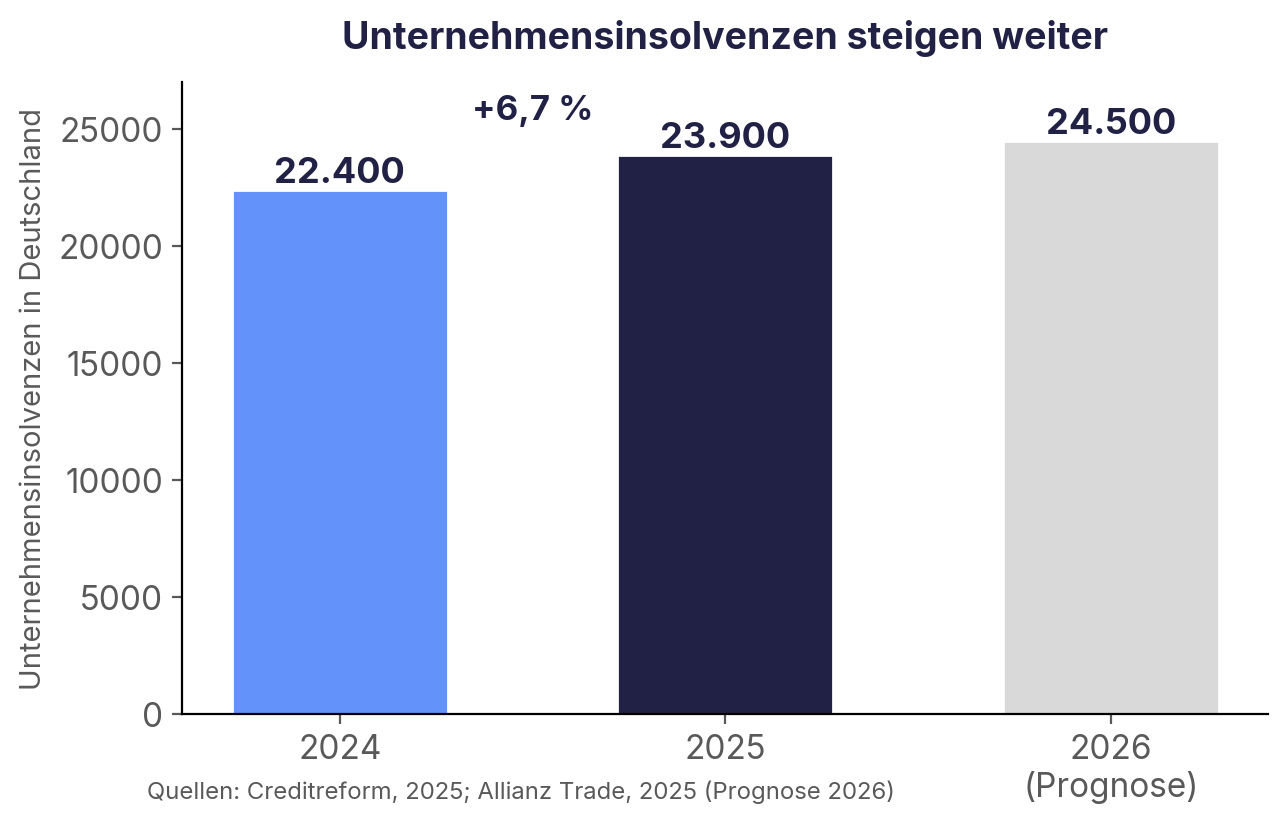
The scale of this risk is evident in the trend of corporate insolvencies in Germany: in 2025, the number of cases climbed to around 23,900—an increase of 6.7% compared to the previous year (Creditreform, 2025). Around 24,500 insolvencies are projected for 2026 (Allianz Trade, 2025). Especially in a strained market environment, cash flow becomes a critical leadership metric.
Cash flow is more than just a protective shield, though—it is also a vital management tool. Understanding your cash movements allows you to spot bottlenecks early enough to take corrective action. At the same time, cash flow shows when you have the leeway to invest, take advantage of early-payment discounts, pay down debt, or pursue growth.
The same metric that warns of risks also shows you when the right moment has come for your next entrepreneurial step.
As a standardized metric that is difficult to manipulate, cash flow creates transparency for management, investors, and lenders. It makes three things visible in particular:
- Financial stability: whether your company generates enough money from its own operations to cover ongoing costs. Flexibility: how much money is available for investments, debt repayment, or distributions. Early warning system: whether financial risks are emerging long before they turn into real payment problems.
Why do so many companies fail because of cash flow?
Because revenue does not equal cash in the bank. A business can have full order books and still run into trouble if invoices are paid late, while wages, rent, suppliers, and taxes fall due immediately. The problem is often not a lack of sales, but a timing gap between delivery, invoicing, and incoming payment.
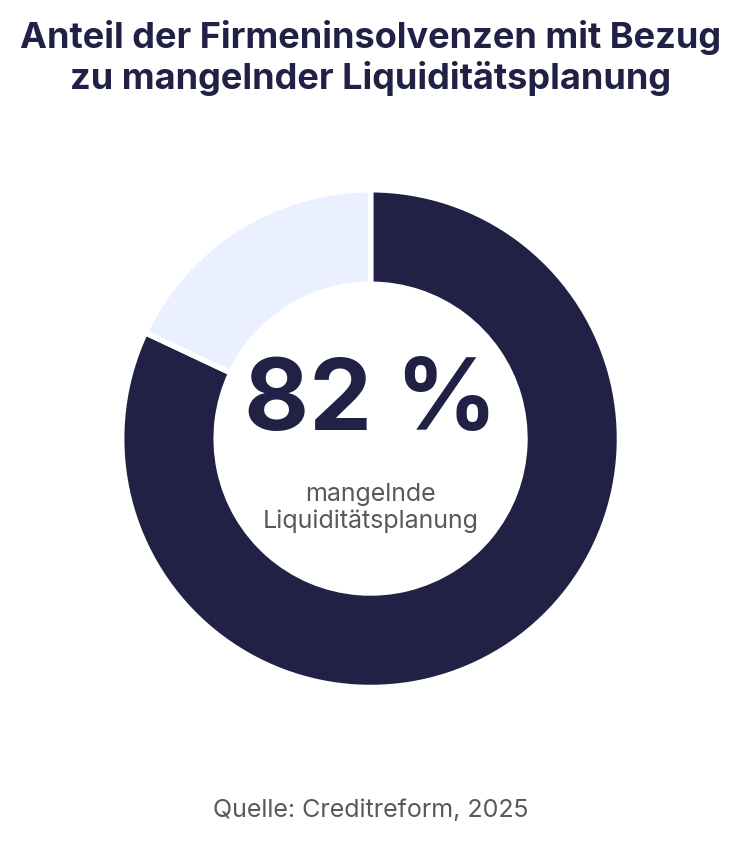
Smaller businesses are hit particularly hard by this, as their reserves are often limited and delayed payments lead to cash crunches much faster. According to Creditreform, micro-enterprises accounted for roughly 82% of all corporate insolvencies in 2025. At the same time, 2019 QuickBooks data shows that 69% of small business owners lose sleep over cash flow worries. This highlights just how much cash flow issues weigh on small businesses day in, day out.
The reason is usually simple: expenses arise constantly, while customer payments arrive later. Even profitable companies can find themselves in dire straits without adequate reserves and planning. That is why cash flow is not merely a finance topic, but a core leadership responsibility. Proactively managing the gap between delivering work and receiving payment ensures you stay agile, even in challenging times.
Why is cash flow so critical right now?
In short: because payment behaviour remains strained and cash often arrives later than businesses need it to cover their ongoing expenses.
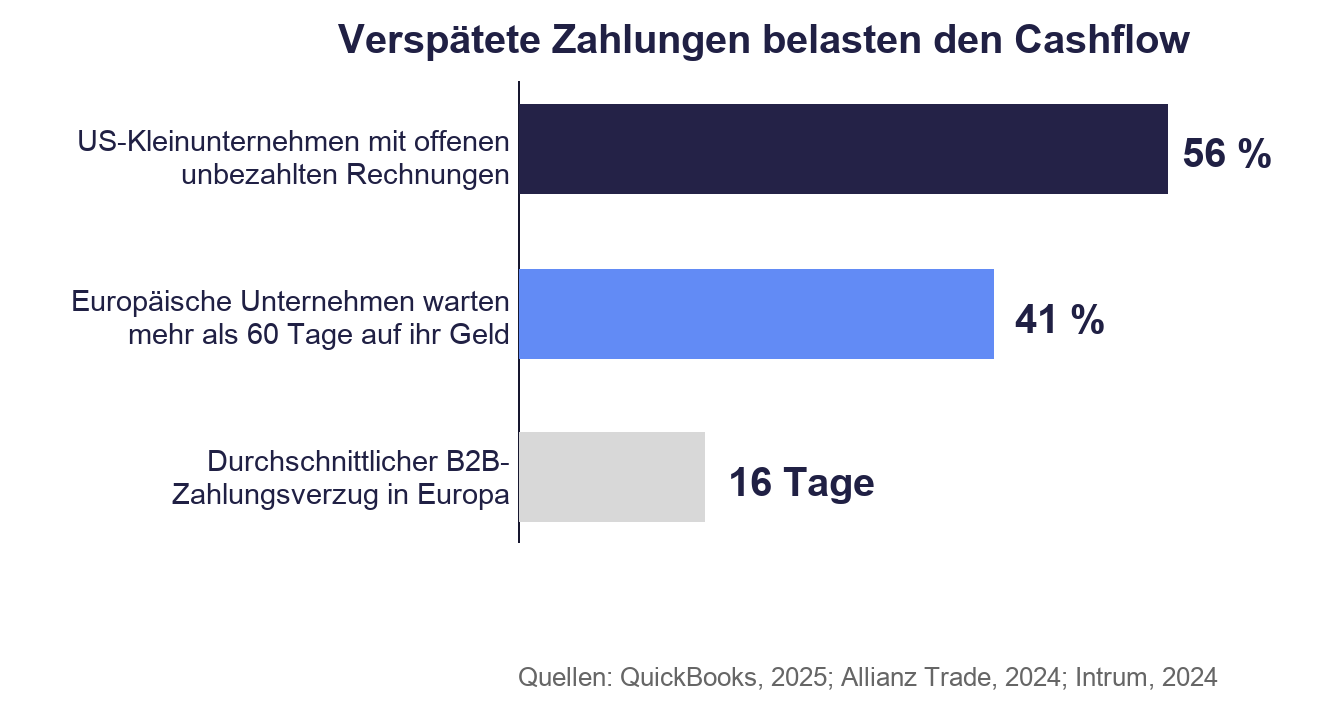
According to Intrum, European companies are waiting on trillions in outstanding receivables; in the B2B sector in 2024, invoices were paid an average of 16 days later than agreed across Europe (Intrum, 2024).
QuickBooks also shows how heavily late or outstanding invoices burden smaller companies: 56% of the US small businesses surveyed had money outstanding from unpaid invoices, averaging 17,500 US dollars per company (QuickBooks, 2025).
Allianz Trade also reports that global Days Sales Outstanding rose to 59 days in 2023 and that longer payment terms can put further pressure on cash flow (Allianz Trade, 2024).
For you, this means: there is often a gap of a month or more between delivering your service and receiving payment. This is precisely the gap your cash flow needs to bridge.
The longer payment terms are and the more irregularly customer payments arrive, the more important forward-looking planning becomes. Otherwise, a late payment can quickly turn into a real bottleneck, even if the business itself is healthy.
What types of cash flow are there?
In a cash flow statement, cash flow is usually divided into three areas: operating cash flow (OCF), cash flow from investing activities (ICF), and cash flow from financing activities (CFF). In addition, free cash flow (FCF) is often considered. It is not a separate category in the cash flow statement, but rather a derived metric that shows how much money remains freely available after ongoing business operations and investments.
Operating Cash Flow (OCF)
Operating cash flow (OCF), also known as cash flow from operating activities, encompasses all regular cash inflows and outflows from core business operations: revenue from sales minus operating expenses like salaries, rent, and taxes. A positive OCF is the clearest indicator of operational strength, proving that the business sustains itself. It is usually the first metric banks and investors look at.
Cash Flow from Investing Activities (ICF)
Investing cash flow reflects cash flows from buying or selling fixed assets, such as machinery, real estate, or equity stakes. A negative cash flow from investing activities is entirely normal during growth phases and is often a healthy sign, indicating that the business is investing in its future. In contrast, a positive investing cash flow resulting from asset sales can point to consolidation or downsizing.
Cash Flow from Financing Activities (CFF)
Financing cash flow (CFF) relates to capital structure: cash inflows from raising equity or debt (shares, bonds, loans) and cash outflows for dividends or loan repayments. A positive CFF means the company is taking on capital, while a negative CFF indicates that capital is flowing back to owners or creditors.
Free Cash Flow (FCF)
Free cash flow indicates how much cash remains after covering operational expenses and necessary capital expenditures. In simple terms, it is calculated as operating cash flow minus capital expenditures (CapEx). It serves as a vital barometer of financial flexibility, showing how much cash is readily available to repay debt, pay dividends, or fund further growth.
A stable or growing FCF is considered a sign of sound corporate management.
In addition to the classification by activity, cash flow is also distinguished between gross and net, i.e., before and after taxes:
Gross and Net Cash Flow
Gross cash flow corresponds to operating cash flow before taxes. Subtracting the taxes actually paid yields net cash flow—the actual cash available to the business after taxes.
The three cash flow areas plus free cash flow at a glance
What is the difference between positive and negative cash flow?
A positive cash flow means that more money is coming in than going out over a given period. A negative cash flow means that more money is flowing out than coming in. Crucially, it's not just the sign that matters, but also the underlying cause: a positive operating cash flow usually signals financial strength, whereas a positive cash flow driven by new borrowing tells a very different story.
Positive Cash Flow: Opportunities and Benefits
A positive cash flow, especially from ongoing business, is an important sign of financial health. Costs can be covered, debts repaid, reserves built, and investments financed. A strong operating cash flow also increases the company's value and makes you more attractive to investors, for example during loan negotiations or financing rounds. It also gives you bargaining power because you can take advantage of early payment discounts and secure better terms.
Negative Cash Flow: Risks and Disadvantages
A negative cash flow means that more money is flowing out than in. In the short term, this can be normal, for example during major investment phases, when building up inventory, or during growth phases with high upfront costs. However, if this state persists and is not planned for, the risk of insolvency and dependence on external financing increases. It is therefore crucial to plan for a negative cash flow consciously rather than only noticing it when liquidity becomes tight.
How can a company have positive cash flow despite making a loss?
This happens because non-cash items such as depreciation and amortisation reduce accounting profit without causing an actual cash outflow. Similarly, cash collected from receivables dating back to previous periods or new financing can bring money in, even when the income statement shows a loss. A company can therefore post a net loss and still remain liquid. This is precisely why cash flow is often more meaningful than net profit.
What does cash flow tell you about your company?
Cash flow indicates how truly sustainable your business model is.
It answers the question of whether your business generates enough cash on its own to cover operating expenses, service debt, and fund growth. This is exactly why operating cash flow is a key metric for leadership teams, banks, investors, and rating agencies alike.
What matters most is the trend over time, not a single snapshot. An isolated negative month is rarely cause for concern. A declining operating cash flow over several periods, however, is a clear warning sign. Cash flow also only paints a full picture when viewed across its different components and in context with other key metrics: negative cash flow from investing activities alongside strong operating cash flow can indicate healthy growth, while positive cash flow driven mainly by new loans calls for caution.
The most common mistakes in cash flow management
In practice, bottlenecks rarely appear out of nowhere. They are usually caused by avoidable mistakes: confusing revenue with liquidity, planning cash inflows too optimistically, ignoring seasonal fluctuations, and lacking a rolling forecast. Knowing these points allows you to take countermeasures early.
- Equating revenue with cash flow: A full order book does not mean money in the bank as long as invoices remain unpaid. Planning only in retrospect: Those who look only at past figures will only recognize bottlenecks once they are already there. Underestimating reserves: Without a liquidity buffer, every late payment immediately becomes a risk.
How do you calculate cash flow? With an example
Cash flow can be calculated in two ways: using the direct method or the indirect method. With the direct method, you track actual cash inflows and outflows directly. With the indirect method, you start with net income and adjust it for non-cash items and changes in working capital.
In simple terms:
Cash flow = cash inflows minus cash outflows
For the indirect method, the simplified formula is:
Operating cash flow = net income + depreciation +/- changes in working capital
Calculating cash flow: a brief example
A company has net income of €150,000, depreciation of €50,000, and an increase in trade receivables of €20,000. The rise in receivables ties up cash because revenue has already been booked, but the money hasn't been collected yet. It is therefore deducted.
Operating cash flow is therefore: €150,000 + €50,000 - €20,000 = €180,000. Depreciation is added back because it reduces profit without causing an actual cash outflow. This example illustrates why cash flow and profit can diverge significantly.
To find out which method to use when, which formulas apply to operating and free cash flow, and how to work through additional practical calculations, check out our step-by-step guide: Calculating Cash Flow: Formulas, Methods & Examples.
Which cash flow metrics are important?
Once the cash flow has been determined, key performance indicators (KPIs) help to contextualize it and assess financial health. Particularly relevant are:
- Cash flow margin: Operating cash flow in relation to revenue. It shows how much of every euro in revenue actually reaches the company as real cash flow. A rising margin is a strong sign of operational efficiency. Free cash flow (FCF): Operating cash flow after deducting investments. It shows how much money actually remains available for debt repayment, distributions, reserves, or growth. Price-to-cash-flow ratio (P/CF): Stock price divided by cash flow per share. This metric is primarily relevant for publicly traded companies and helps investors assess a company's valuation.
Additionally, the discounted cash flow (DCF) plays an important role in company valuation. In this method, expected future cash flows are discounted to their present value. Therefore, the DCF is not an operational cash flow metric, but rather a valuation method.
For context: the average equity ratio among German SMEs recently stood at 30.7% (KfW SME Panel, 2025). This reflects the financial cushion businesses have to absorb cash flow fluctuations. The thinner the capital cushion, the more critical stable operating cash flow becomes. You'll find the exact formulas in our detailed guide to calculating cash flow.
How do you actively manage your cash flow?
Knowing your cash flow is only half the battle; actively managing it is the other. That is precisely the role of cash flow management: continuously planning, forecasting, and steering your cash flows. Regular forecasts allow you to spot early on how your liquidity will develop in the weeks ahead.
Even so, 72% of treasury professionals still compile their cash flow forecasts manually (PYMNTS, 2022)—a process that is both time-consuming and error-prone.
Scenario analyses are especially valuable. By running through best-case to worst-case projections, you can instantly see the impact of an investment, a drop in sales, or a delayed customer payment. We break down the methodology behind this in our article on Scenario Planning and Forecasting.
Automation is also gaining traction in cash management: according to PYMNTS, 70% of surveyed companies are already using at least one AI tool to manage their cash flow (PYMNTS, 2026).
Practical tip from finance experts: “In practice, many businesses underestimate the time lag between issuing an invoice and receiving payment. A rolling 13-week forecast exposes that exact gap, turning gut feeling into reliable decision-making.” A tool like Tidely delivers this by integrating bank accounts and forecasts automatically on a daily basis. Discover how dedicated cash flow management software handles this for you—including 13-week planning at the click of a button—right here.
How can you improve your cash flow?
You can improve your cash flow using two levers: bringing money in faster and spending money more strategically. The biggest lever often lies in receivables management, as outstanding invoices tie up liquidity exactly where it is actually needed in the company.
- Manage receivables actively: Shorter payment terms, clear dunning processes, and incentives for early payment reduce the time your money stays with the customer. Time your expenses: Choose supplier terms and payment dates so that outflows and inflows align better. Reduce inventory and capital commitment: Less capital tied up in inventory frees up liquidity. Plan ahead: A rolling cash flow forecast reveals bottlenecks before they arise. This is one of the most effective protective mechanisms against payment problems. Use a cash flow management tool: A tool like Tidely bundles bank accounts, cash flows, and forecasts in one place. This allows you to see faster when money is getting tight, which payments affect cash flow, and where you can take countermeasures.
These measures work together: those who tighten receivables, manage expenses, and plan regularly make their cash flow predictable rather than reactive. This reduces the risk of running into a bottleneck, even with full order books.
You'll find more actionable strategies in our Tips for Improving Liquidity. Early-stage businesses will also benefit from taking a closer look at Burn Rate and Cash Runway.
Conclusion: Understand, plan, and manage cash flow
Cash flow is the most honest metric of your company. It shows how much money is actually flowing, not how much profit is on paper. Anyone who understands the three cash flow areas, can contextualize free cash flow, distinguish between positive and negative cash flow, and actively plan their cash flow, lays the foundation for sustainable growth.
In view of rising insolvency numbers, longer payment terms, and delayed incoming payments, this is no longer just a "nice-to-have." The next step is concrete calculation, followed by ongoing, ideally automated, management. This is how a metric becomes a real management tool for your company.
Frequently asked questions about cash flow (FAQ)
What is cash flow, explained simply?
Cash flow is the difference between all cash inflows and outflows of a company over a specific period. It shows how much money is actually flowing through the business, regardless of accounting items like depreciation.
What does cash flow mean?
Cash flow refers to the movement of money. The term describes the net flow of cash into and out of a business. A positive cash flow means more money is coming in than going out. A negative cash flow means more money is going out than coming in.
Is cash flow the same as profit?
No. Profit is an accounting result and can include non-cash items. Cash flow measures the actual movement of money. A company can be profitable and still be short on cash, or report a loss and still remain liquid.
What types of cash flow are there?
In a cash flow statement, cash flow is usually divided into three areas: operating cash flow (OCF), investing cash flow (ICF), and financing cash flow (CFF). Free cash flow (FCF) is an additional metric that shows how much money remains after investments.
What is a good cash flow?
A good cash flow is generally consistently positive in the operating area. This means the company generates enough money from its core business to cover costs, build reserves, pay off debt, and invest. What constitutes a "good" cash flow depends on the industry, growth stage, and investment needs.
Where is cash flow found on the balance sheet?
Cash flow is not listed directly on the balance sheet. It is reported in the cash flow statement, which explains how cash and cash equivalents have changed over a specific period.
Is cash flow calculated before or after taxes?
Both are possible. Operating cash flow usually accounts for taxes paid because they are actual cash outflows that affect liquidity. Gross cash flow is viewed before taxes, while net cash flow is viewed after taxes.
How can I improve my cash flow?
You can improve your cash flow by collecting receivables faster, timing your expenses more strategically, reducing capital tied up in inventory, and using rolling cash flow forecasts to identify bottlenecks early.
Sources
About the author

Niclas Storz is the founder and CEO of Tidely, a software solution for cash flow management for small and medium-sized enterprises. Previously, he spent over 20 years working as a management consultant, most recently as a Senior Partner & Managing Director at BCG.