<w0>Avoid liquidity shortages: How to protect your business from financial bottlenecks</w0>
A liquidity shortage can be a serious challenge for any business. When there is suddenly not enough cash available to cover ongoing expenses, entrepreneurs can quickly find themselves in a life-threatening situation. But how exactly does such a bottleneck occur, and more importantly: how can you avoid it? In this article, we explain what you should look out for and which measures will help you identify and prevent liquidity shortages early on.

Key takeaways
- A liquidity shortage means there is not enough cash in the account in the short term to pay due obligations like wages, rent, or supplier invoices on time. Even profitable companies are affected.
- The most common causes are delayed incoming payments, fluctuating revenue, unexpected expenses, rapid growth, and a lack of financial planning.
- You can spot an impending shortage early by comparing incoming and outgoing payments on a rolling basis. If your projected account balance dips into the red, it is time to act.
- In an acute situation, a mix of overdraft facilities, factoring, suspending repayments, and negotiating payment terms helps. Prevention is cheaper than bridging.
- The most effective protection is proactive liquidity planning. Those who see shortages weeks in advance have time to make calm, sound decisions.
What is a liquidity shortage?
A liquidity shortage occurs when your company lacks the liquid assets in the short term to meet payment obligations on time. The Gabler Wirtschaftslexikon (2024) defines liquidity as a company's ability and willingness to meet its payment obligations on time and in the correct amount. It is precisely this ability that is temporarily disrupted during a shortage.
Important: A shortage is not a sign that your business model isn't working. A company can be highly profitable and still run into a shortage because payments come in later than the payment obligations are due. Liquidity and profit are two different things. Our article Calculating Liquidity shows you how to properly determine your liquidity.
In short: A liquidity shortage is a short-term lack of cash: there is enough substance, but not enough money in the account at the wrong moment. It concerns the timing of available funds, not profitability. This is why profitable, growing companies are regularly affected.
When does a liquidity shortage occur?
A shortage arises when regular outgoing payments meet delayed or irregular incoming payments. As long as the planned account balance remains positive at the end of the month, everything is in the clear. As soon as due outgoing payments exceed available funds, a liquidity shortage exists. The decisive factor is therefore not the amount of your revenue, but the timing of the cash flows.
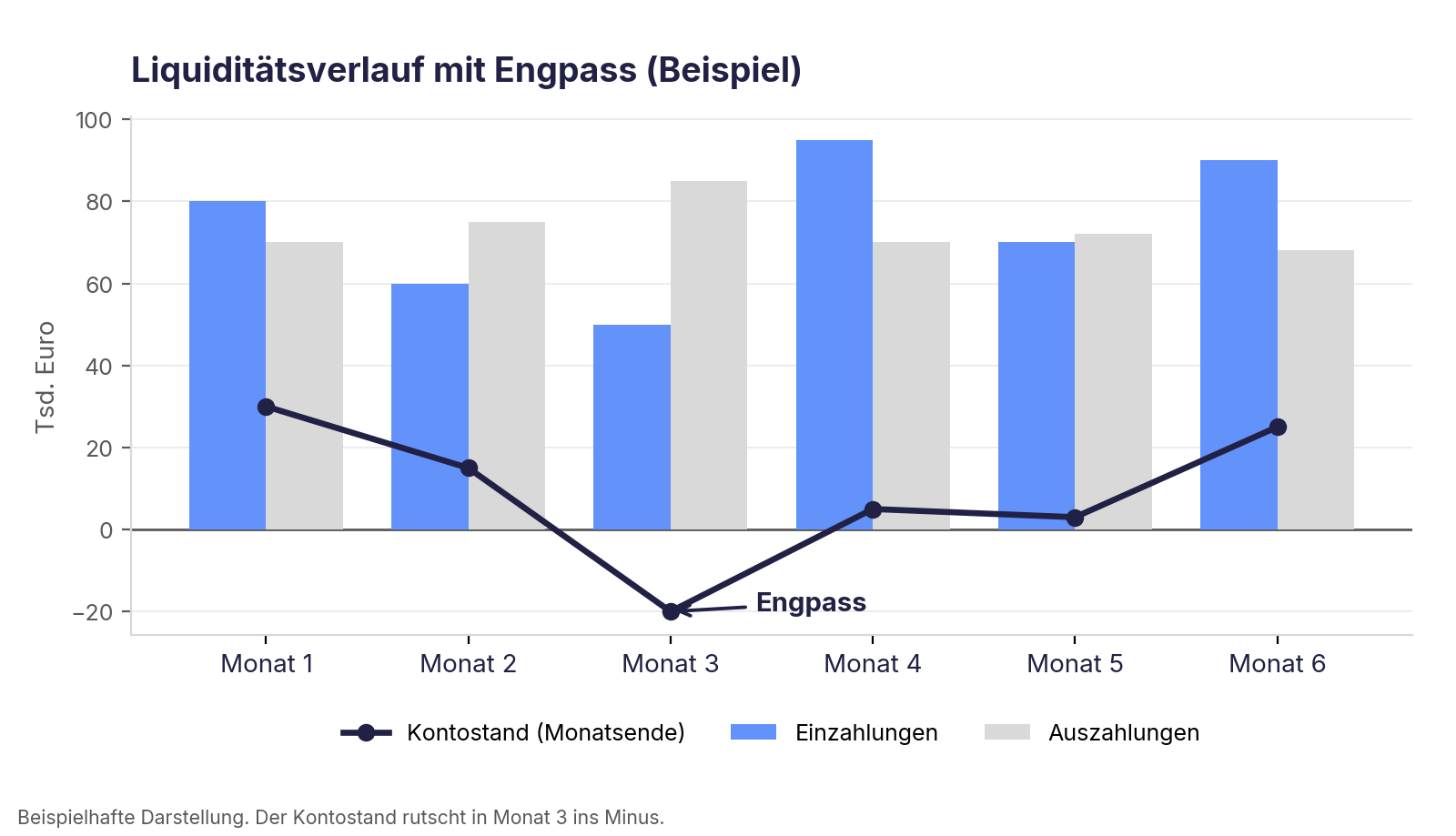
Liquidity trend with a shortage (example): In month 3, outgoing payments exceed available funds, and the account balance slips into the red.
Liquidity shortage: A practical example
A medium-sized mechanical engineering firm wins two major orders with 60-day payment terms. They must pre-finance materials for production, and many suppliers require down payments. Wages, rent, and leasing installments continue as usual. The order book is full, the company is profitable, yet a shortage occurs for several weeks because the money from the orders arrives later. This is exactly where proactive planning pays off.
How do you calculate a (looming) liquidity shortage?
You calculate an impending liquidity shortage by determining the expected account balance for each period. The basic formula is simple:
Ending balance = Opening balance + expected incoming payments − expected outgoing payments
You should perform this calculation not just for the current month, but on a rolling basis for the coming weeks and months. This allows you to see early on in which period the account balance will become tight or slip into the red. The following calculation example shows how a shortage becomes visible before it occurs (values in thousands of euros):
A negative closing balance in month 3 is your warning sign. Because you can already see it in your planning in month 1, you have time to take countermeasures, such as bringing a payment forward or deferring an outgoing payment. You can find a structured template and guide for this in our article Liquidity Planning.
How can you spot a liquidity crunch early on?
You can identify a liquidity crunch early by watching for clear warning signs in payment behavior and your planning. The sooner you notice them, the more room you have to maneuver. Keep an eye out for these indicators:
- Outstanding receivables are increasing, and customers are paying later than agreed on average.
- Your account balance is dropping over several weeks, even though business is good.
- You are using your overdraft facility permanently instead of just as a short-term buffer.
- You are missing out on supplier discounts because cash is tight.
- Planned outgoing payments for the coming weeks exceed expected incoming payments.
To turn a signal into immediate action, it helps to consider the cause, the early warning sign, and the countermeasure together:
What causes a liquidity crunch?
Most liquidity crunches stem from one of five causes. Knowing them allows you to take targeted preventative measures.
1. Delayed incoming payments
Long payment terms of 30, 60, or 90 days are the most common cause. Late payments tie up enormous sums across Europe: according to the Intrum European Payment Report (2024), European companies are waiting on at least 10.5 trillion euros in outstanding receivables and spend an average of 73 working days per year chasing late payments. Regularly monitoring open items and following up in a friendly but firm manner will keep your cash flowing.
2. Unforeseen expenses
Repairs, rising purchase prices, tax arrears, or short-term investments put a strain on liquidity. A solid financial plan always includes a buffer for such cases so that a single event doesn't derail the entire month.
3. Fluctuating revenue
Seasonal fluctuations lead to irregular income while costs remain constant. Those who know their weak months build up reserves during strong months and plan using scenarios rather than a single best-case projection.
4. Growth without sufficient liquidity
Growth costs money upfront: more staff, more materials, more pre-financing. Furthermore, capital reserves in small and medium-sized enterprises are often thin. According to the KfW SME Panel (2025), the average equity ratio is 30.7 percent, and around 28.4 percent of companies have less than ten percent equity. If you are growing, you should financially back that growth and include working capital requirements in your planning.
5. Lack of financial planning
If you lack an overview of income and expenses for the coming weeks, every crunch comes as a surprise. This is exactly what can be avoided. A daily updated overview turns flying blind into a manageable route.
What are the effects of a liquidity crunch?
A short-term crunch is manageable. However, if left unaddressed, it can spiral. You should be aware of these four effects:
- Weaker supplier relationships: Late payments cost trust; in the worst case, partners may only supply against advance payment.
- Poorer creditworthiness: Banks pay attention to timely payments. A crunch can worsen your rating and, consequently, your financing terms.
- Less room for daily operations: If you lack a buffer, you cannot take advantage of opportunities like early payment discounts or favorable bulk purchases.
- Existential risk if chronic: A persistent crunch can lead to insolvency.
The economic environment highlights just how relevant this topic is: in 2025, approximately 23,900 companies in Germany filed for insolvency, an increase of 8.3 percent compared to the previous year (Creditreform, 2025). Micro-enterprises with up to ten employees accounted for 81.6 percent of these cases (Creditreform, 2025). Official statistics confirm this trend: in December 2025, the number of regular insolvency filings rose by 15.2 percent compared to the same month the previous year (Destatis, 2026). Allianz Trade (2025) expects a further increase of around 2 percent for 2026.
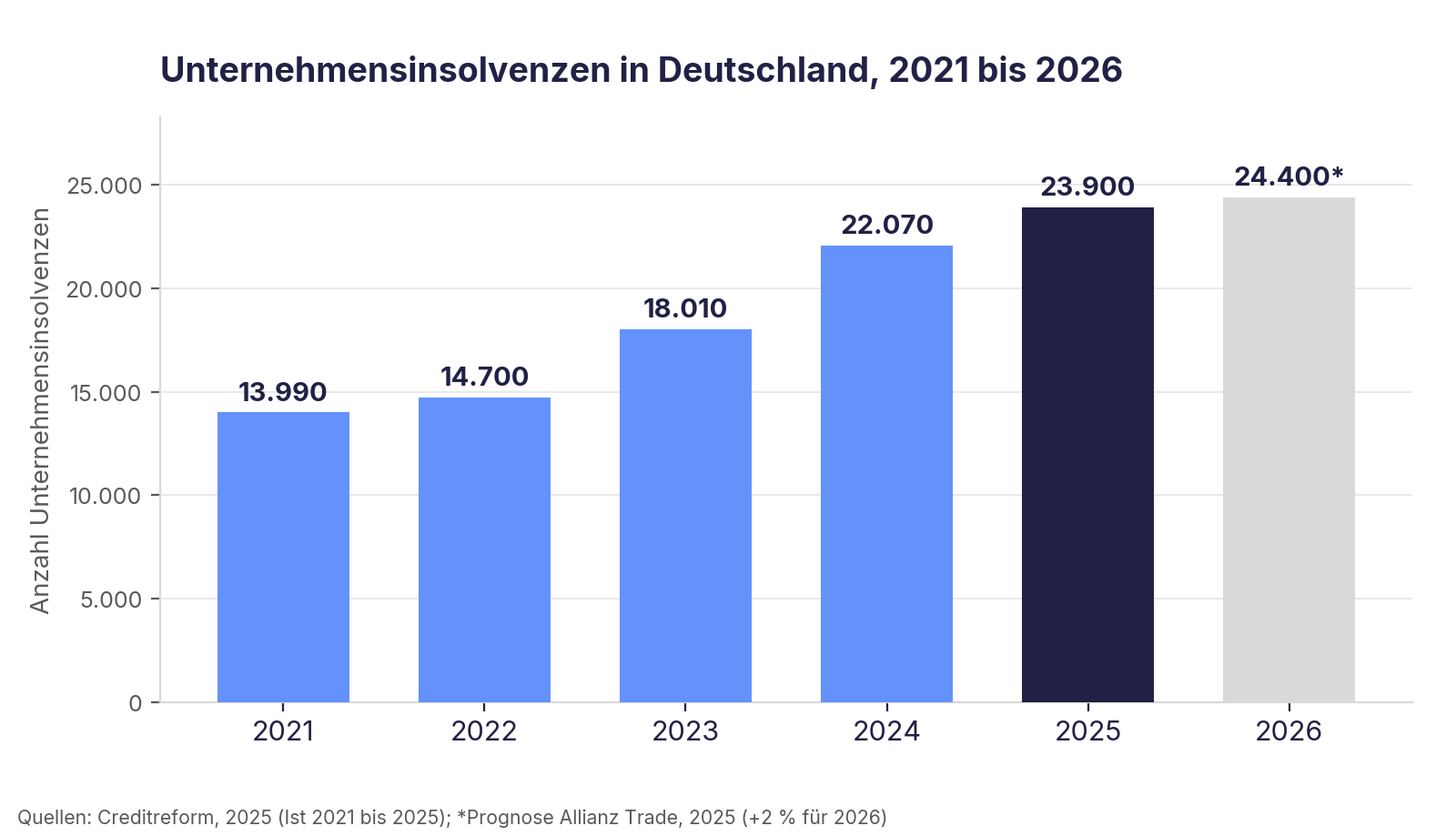
Corporate insolvencies in Germany from 2021 to 2026. The good news: a cash crunch is predictable and manageable with proactive planning.
In short: The impact of a cash crunch ranges from weakened supplier relationships and lower credit ratings to existential risk if it becomes permanent. Given the approximately 23,900 corporate insolvencies in 2025 (Creditreform, 2025), keeping a close eye on liquidity is not a luxury—it is essential for maintaining operational capability.
How do you bridge an acute liquidity crunch?
If a crunch is already underway, speed is everything. Several levers can provide breathing room in the short term. It is best to combine them to suit your specific situation:
Factoring is particularly suitable when a lot of capital is tied up in outstanding receivables. You can read about how it works and when it pays off in our article Maximizing liquidity with factoring.
How do you avoid liquidity crunches in the long term?
You can avoid long-term crunches by making them visible before they occur. Prevention is almost always cheaper and less stressful than emergency bridging. Four approaches have proven effective:
- Rolling planning: Continuously compare incoming and outgoing payments for the coming weeks and months. This allows you to spot any looming crunch weeks in advance.
- Keep receivables low: Clear payment terms, early payment discounts, and friendly, consistent reminders shorten the time until payment is received.
- Build buffers: A liquidity reserve absorbs unexpected expenses without needing to tap into your overdraft facility.
- Think in scenarios: Plan for best, base, and worst-case scenarios so you are prepared for various outcomes.
The real potential lies in automation: according to PYMNTS (2022), 72 percent of finance managers still create their cash flow forecasts manually, usually in spreadsheets. This is exactly where digital tools come in. Our article Scenario planning and forecasting shows you how to plan securely using scenarios and forecasts. For an overview of the big picture, see our guide on liquidity management.
Why are liquidity crunches particularly common in autumn and at the end of the year?
In the fourth quarter, several financial burdens hit your account at the same time. This makes autumn the classic season for cash crunches, but you can prepare for it effectively. These factors converge at the end of the year:
- Tax prepayments and potential back payments in the fourth quarter tie up funds.
- Christmas bonuses and special payments increase payroll costs in November and December.
- Christmas and year-end business often requires pre-financing before the revenue arrives.
- Many customers pay later during the holiday season, while your fixed costs continue unabated.
Practical insights
The best time to plan your liquidity for the turn of the year is early autumn. Those who set up a rolling plan through the first quarter in September and October will spot the December peak in time and can smooth out payments, build reserves, or negotiate payment terms. This turns the "crunch season" into a well-prepared phase. You can find a suitable foundation in our article Creating a financial plan.
How does a liquidity management tool help avoid crunches?
A liquidity management tool like Tidely makes crunches visible before they happen. Instead of calculating in Excel once a month, you see your liquidity in real-time with a forward-looking view. Tidely connects to your bank accounts, automatically categorizes payments, and creates an auto-forecast for the coming months based on your history.
For the early detection of crunches, a forward-looking perspective is crucial. With liquidity control, you keep an eye on incoming and outgoing payments in real-time, and with scenario analysis, you can compare best, base, and worst-case scenarios with just a few clicks. This allows you to identify critical weeks early and make decisions calmly rather than under pressure.
Try Tidely free for 7 days
Get an up-to-date overview of your liquidity and identify bottlenecks before they happen. Try Tidely free for 7 days now, no credit card required.
Frequently asked questions about liquidity bottlenecks
What is a liquidity shortage?
A liquidity bottleneck is a short-term shortage of liquid assets. The company temporarily lacks the cash to make due payments such as wages, rent, or supplier invoices on time. Even profitable companies can be affected if incoming payments arrive later than the outgoing payments are due.
When does a liquidity shortage occur?
A liquidity bottleneck occurs when due payments in a given period exceed available funds and expected incoming payments. In your planning, you can spot this when the projected account balance at the end of the period drops into the negative.
How do I calculate a liquidity bottleneck?
You calculate it by performing the following for each period: opening balance plus expected incoming payments minus expected outgoing payments. By doing this calculation on a rolling basis for the coming weeks and months, you can see early on when your account balance will become tight or negative.
What should I do if I have a liquidity bottleneck?
First, check your outstanding receivables and consistently follow up on overdue payments. Negotiate longer payment terms with suppliers and cut non-essential expenses in the short term. If that is not enough, an overdraft facility, a suspension of loan repayments, or factoring can help to generate liquidity quickly.
What causes a liquidity bottleneck?
Common causes include delayed incoming payments due to long payment terms, fluctuating sales, unforeseen expenses, rapid growth without sufficient reserves, and a lack of financial planning. Usually, several factors work together.
Is a liquidity bottleneck the same as insolvency?
No. A liquidity bottleneck is a short-term, usually solvable problem regarding solvency. It only becomes insolvency if it persists and the company is no longer able to meet its payment obligations.
Can I avoid liquidity bottlenecks with an app?
Yes. A liquidity management tool like Tidely connects to your bank accounts, shows your liquidity in real time, and creates forward-looking forecasts. This allows you to identify looming bottlenecks weeks in advance and take countermeasures in time.
Sources
Creditreform: Insolvencies in Germany, year 2025
Federal Statistical Office (Destatis): Filed standard insolvencies in December 2025, 2026
Allianz Trade: 2025 Insolvency Study, insolvencies rising faster than expected, 2025
Intrum: European Payment Report 2024, 2024
PYMNTS: 72% of Treasurers Still Do Cash Flow


.webp)
.png)