Working Capital: Definition, Calculation & Optimization
Working capital is one of the most important metrics when it comes to your company's short-term financial strength. It answers a simple but crucial question: are your short-term assets sufficient to cover your current liabilities? For SMEs and mid-sized businesses in particular, this is more than just a balance sheet figure, as capital tied up in inventory and outstanding receivables is capital that is unavailable for growth and investment elsewhere. In this guide, you will learn exactly what working capital is, how to calculate it step-by-step, which benchmarks apply to your industry, and the levers you can use to optimize it effectively. Includes worked examples and an analysis of the cash conversion cycle.
.png)
Key takeaways
- Definition: Working capital is the difference between current assets and current liabilities.
- Formula: Working capital = current assets − current liabilities. A positive value means that current assets exceed current liabilities.
- Benchmark: A working capital ratio of 100% or more means current liabilities are covered, with 130% to 200% generally considered healthy. These figures vary by source and industry. The goal is to optimize rather than maximize, as excessive tied-up capital reduces returns.
- Benchmark: For German SMEs, the median cash conversion cycle is approximately 55 days, with an average optimization potential of about 12.5% of revenue (Grant Thornton, 2023).
- Levers: Inventory, accounts receivable, and accounts payable. Managing these effectively shortens the cash conversion cycle and frees up liquidity.
- Looking ahead: Working capital is a snapshot in time. Only when combined with rolling liquidity planning can you see how your decisions impact future solvency.
What is working capital: a simple explanation
In short: Working capital is current assets minus current liabilities. This metric shows how much short-term capital is tied up in day-to-day operations and whether your company can pay its current bills using its own resources.
To make this metric easier to grasp, it is worth looking at its two components.
Current assets and current liabilities
Current assets include all assets that can normally be converted into cash within one year: bank balances and cash on hand, outstanding accounts receivable, as well as inventory and stock.
Current liabilities include everything that falls due within one year:
- accounts payable to suppliers,
- short-term bank loans and overdraft facilities, as well as
- outstanding tax and payroll obligations.
Why working capital is so important for SMEs
Working capital is the bridge between your balance sheet and your day-to-day operations. It determines whether you can pay wages, rent, and supplier invoices on time without having to resort to expensive short-term financing. This is relevant because the average equity ratio among SMEs is only 30.7% (KfW SME Panel, 2025) and 43% of companies rate their financial situation as problematic (DIHK, 2025).
On the positive side: Healthy working capital gives you breathing room. You can take advantage of early payment discounts, invest in growth, and negotiate with suppliers and banks from a position of strength. Our guide shows you how to determine your overall solvency: Calculating liquidity.
How do you calculate working capital?
In short: You calculate working capital using a simple formula: current assets - current liabilities.
Additionally, the working capital ratio shows the relationship between the two figures as a percentage. You can find both values directly in your balance sheet or management report.
The working capital formula
As mentioned, the basic formula is very simple:
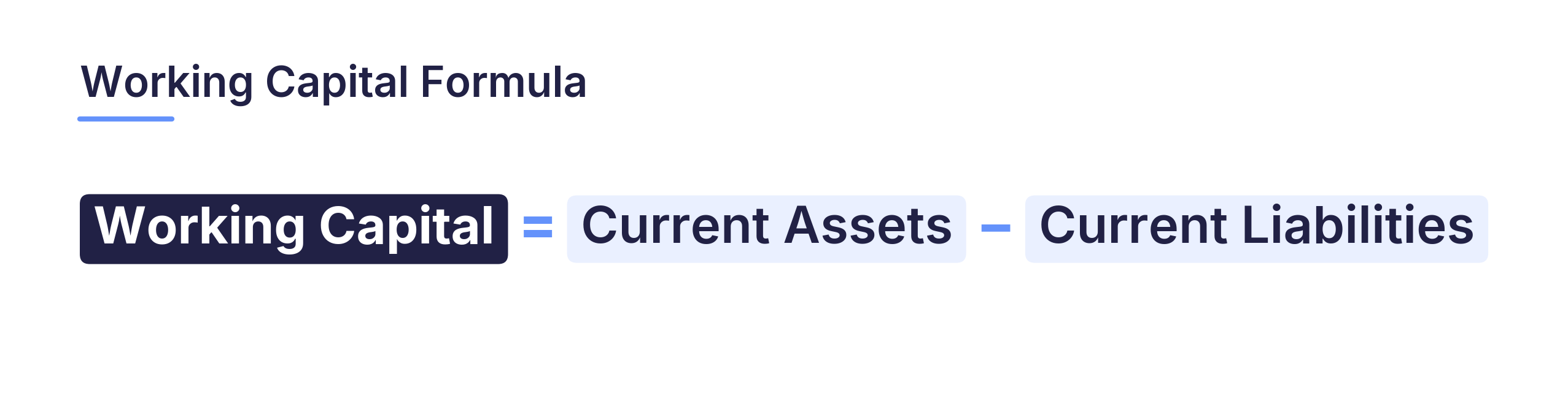
A positive result means that your current assets exceed your current liabilities. A negative result means that your current liabilities are greater than your current assets.
Calculation example for an SME
Take a trading company with the following balance sheet items:
The working capital is 60,000 euros. This means the company could fully cover its short-term debt using its current assets and would still have a buffer remaining.
Calculating the working capital ratio and working capital margin
The absolute euro value alone doesn't tell you much about the scale. That is why you put it into perspective. Two key figures are commonly used for this (Deutsche Bank, n.d.):
- Working capital ratio: Current assets ÷ current liabilities × 100.
→ In the example: 150,000 ÷ 90,000 × 100 = approximately 167%.
- Working capital margin: Working capital ÷ current assets × 100.
→ In the example: 60,000 ÷ 150,000 × 100 = 40%.
The working capital ratio is the most common form. It corresponds to the current ratio and shows the percentage to which short-term debt is covered by current assets. We will clarify what constitutes a healthy value below.
What is the difference between working capital and net working capital?
In short: In most German sources, net working capital means the same thing as working capital, i.e., current assets minus current liabilities (Gabler Wirtschaftslexikon, n.d.). Only in a narrower interpretation does operating net working capital focus exclusively on the core business.
Net working capital = current assets − current liabilities
However, there is a narrower, more precise business interpretation. Operating net working capital excludes items that are not part of the core business, such as bank balances and short-term financial liabilities:

This version shows how much capital is tied up solely in the operating cycle of purchasing, inventory, sales, and payment terms. For managing day-to-day operations, it is often more informative than the broader definition. The only important thing is that you always use the same definition for comparison.
Is high or low working capital better?
Positive working capital is generally considered a good sign, as it means a company can cover its short-term debts on its own. However, it should not be too high.
If it is consistently negative, it can be a warning sign, because short-term debts are not covered by short-term assets.
However, very high working capital is not automatically better. It can mean that too much money is tied up in full warehouses and long customer payment terms.
This capital is then locked away and is not available for investments or debt reduction. This is precisely the profitability trap that professional sources warn about (Deutsche Bank, n.d.).
You can read about how to take early countermeasures when things get tight in the article Avoiding liquidity bottlenecks.
What does negative working capital mean?
Negative working capital usually means that current liabilities exceed current assets. This can indicate liquidity problems.
However, the business model is the deciding factor:
A retailerthat collects payment immediately via cash or card but pays for its goods 30 to 60 days later is effectively financing its operations through its suppliers. In this case, negative working capital is a sign of efficiency, not financial distress.
In industries with long lead times, such as manufacturing or project-based businesses, consistently negative working capital is risky. In these cases, the buffer needed to pre-finance wages and materials before customer payments arrive is missing. Whether a negative value is good or bad can therefore only be assessed within the context of the specific industry.
How high should working capital be? Guidelines and industry benchmarks
As a rough guideline, a working capital ratio between 100% and 200% is considered healthy (Creditreform, 2025). However, the ideal value depends heavily on the industry: retail and e-commerce often operate with very low or negative working capital, whereas manufacturing and project-based businesses tie up significantly more capital.
- A working capital ratio above 100% means that current assets exceed short-term liabilities (Creditreform, 2025).
- A range of approximately 130% to 200% is often considered comfortable (Controllingportal, n.d.).
- Values significantly above 200% often indicate excessive inventory levels or slow incoming payments (Creditreform, 2025).
Guideline: A working capital ratio of 100% or more means that short-term liabilities are covered, with around 130% to 200% often considered healthy. These values vary depending on the source and industry. The rule of thumb is to optimize rather than maximize, as too much tied-up capital reduces returns.
Industry benchmarking is more meaningful than a static percentage. The following overview shows typical patterns:
A study on German SMEs shows just how much is at stake in practice:
The median cash conversion cycle is around 55 days, with an average optimization potential of approximately 12.5% of revenue (Grant Thornton, 2023).
For 10 million euros in revenue, this mathematically equates to around 1.25 million euros in liquidity that could be unlocked through better working capital management.
What is the cash conversion cycle and how does it relate to working capital?
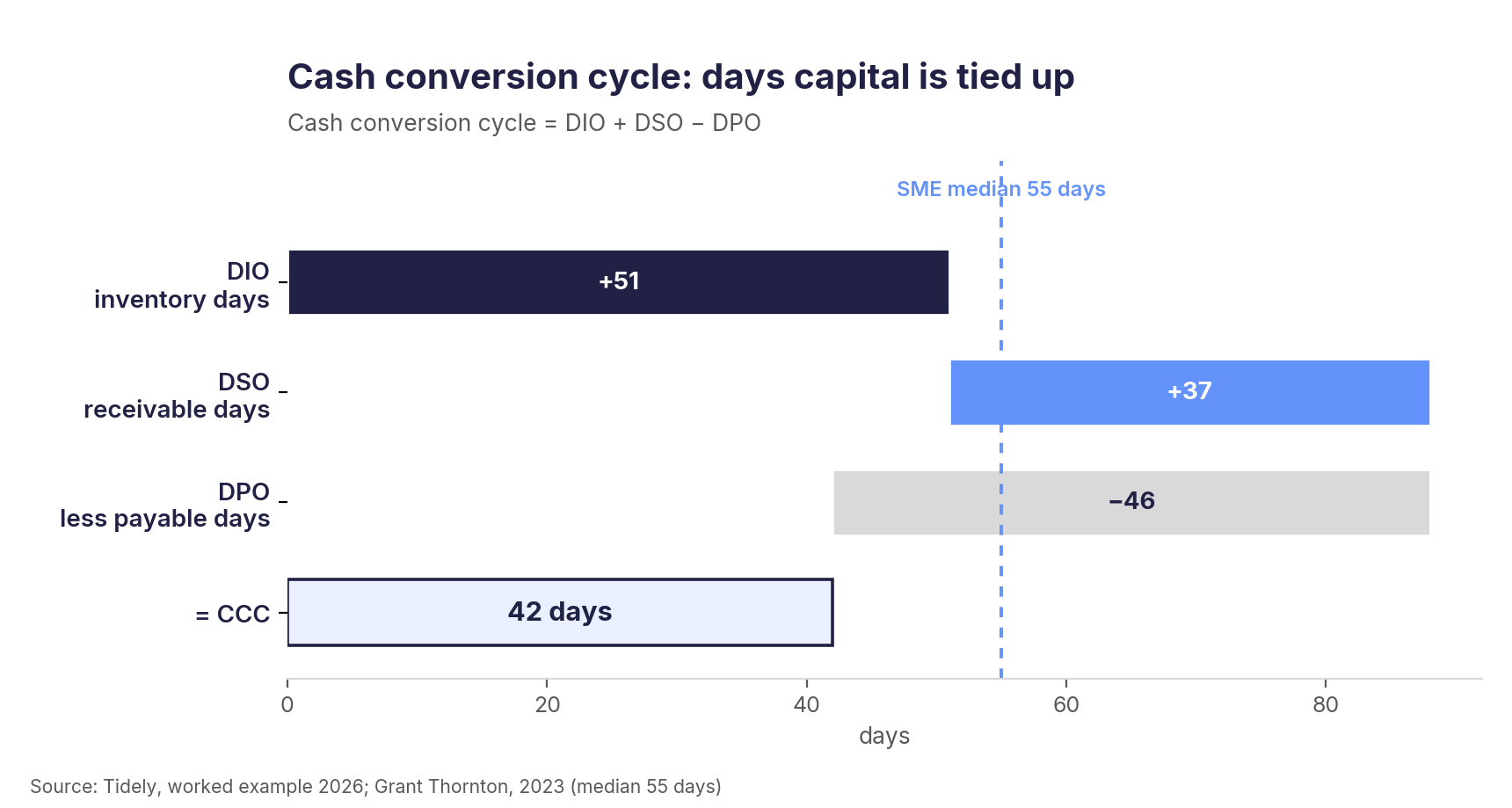
In short: The cash conversion cycle connects three key metrics: DIO (days inventory outstanding, derived from inventory turnover), DSO (days sales outstanding, or how long it takes your customers to pay), and DPO (days payable outstanding, or your own payment terms). The formula is: DIO + DSO − DPO. The lower the value, the faster tied-up capital is converted back into cash.
The cash conversion cycle measures in days how long capital is tied up in operations from the moment of purchase until it returns to your account from sales. It adds a time dimension to working capital.
In other words: Working capital is a snapshot in time. The cash conversion cycle (CCC) turns this into a time-based metric, showing how quickly tied-up capital is converted back into cash.
The rule is: The shorter the cycle, the less capital you need to finance the same business (Controllingportal, n.d.).
The cash conversion cycle consists of three components:
- DIO (Days Inventory Outstanding): the average length of time inventory is held.
- DSO (Days Sales Outstanding): the average time it takes for customers to pay their invoices.
- DPO (Days Payables Outstanding): the average time you take to pay your suppliers.

A calculation example based on our trading company (annual revenue €600,000, cost of goods sold €360,000):
At 42 days, the example company is below the median for small and medium-sized enterprises.
Every day you shorten the cycle, you free up capital. This is exactly where optimization comes in.
What is Working Capital Management?
In short: Working Capital Management is the active control of inventory, receivables, and payables with the goal of tying up as little capital as possible and keeping the cash conversion cycle short. It transforms a static balance sheet figure into an ongoing management task (Creditreform, 2025).
While the working capital metric only reflects a single reporting date, working capital management is a continuous process. It integrates purchasing, inventory, sales, and financial accounting so that tied-up capital is converted back into liquidity as quickly as possible.
The goal is not to minimize working capital, but to optimize it: maintaining enough of a buffer to remain solvent and capable of delivery at all times, while keeping dead capital to a minimum.
The effect is immediate: Every day you shorten the cash conversion cycle, you free up tied-up capital that you can use for investments, early payment discounts, or paying down expensive debt.
This makes working capital management less about window dressing and more about a genuine self-financed leverage tool.
In practical terms, working capital management focuses on three levers, which we will examine in detail in the next section: inventory, accounts receivable, and accounts payable.
How can you optimize your working capital?
You can optimize working capital using three levers:
- Reduce inventory,
- collect receivables faster, and
- fairly extend payment terms with suppliers.
The goal is not maximum working capital, but optimal working capital: enough of a buffer for security, but as little tied-up capital as possible (Creditreform, 2025).
Optimize inventory
Reduce slow-moving items and excess stock, streamline your product range, and use just-in-time procurement where possible. Faster inventory turnover lowers your DIO and thus your cash conversion cycle, without compromising your ability to deliver.
Actively manage receivables
Issue invoices immediately upon delivery, agree on clear payment terms, and offer early payment discounts as an incentive. Performing credit checks before taking on large orders reduces the risk of default. Every day shaved off your DSO directly shortens the cycle.
Manage payables and procurement
Negotiate fair, longer payment terms with suppliers and consolidate purchases to secure better conditions. Balance is key: skipping early payment discounts just to extend payment terms rarely pays off, as discounts are usually the more cost-effective form of financing.
Financing working capital
Where operational levers are not enough, financing instruments can bridge short-term capital needs. The most common options are:
- Overdraft or working capital loan: a flexible line of credit from your bank that cushions short-term gaps between outgoing and incoming payments.
- Factoring: You sell outstanding invoices to a service provider and receive immediate liquidity instead of waiting for your customers to pay. This also lowers your DSO.
- Supply Chain Finance (Reverse Factoring): a financial partner settles your supplier invoices immediately, while you pay them back later. This effectively extends your payment terms (DPO) without straining your supplier relationships.
- Inventory Finance: a financier pays for your inventory upfront, allowing you to build up stock without immediately tying up your own capital.
These tools provide short-term breathing room, but they don't address the underlying operational issues. Therefore, the rule is: optimize your processes first, then finance strategically.
REAL-WORLD EXAMPLE
An agency with an average payment term of 60 days switches to invoicing immediately upon project completion and offers a 2% discount for payments made within 10 days. DSO drops to around 35 days. With an annual turnover of 1.2 million euros, this means around 82,000 euros are no longer permanently tied up in outstanding receivables, but are instead available for salaries and growth.
Working Capital and Liquidity Planning: Why Looking Ahead Is Key
Working capital is a snapshot in time and looks at the past. For effective management, you also need to look ahead!
This is how your working capital directly impacts your operating cash flow: every euro you free up from inventory and receivables strengthens your cash flow and your financial flexibility.
A rolling liquidity forecast shows how changes in inventory, payment terms, or receivables will affect your future solvency before things get tight.
Why is this important?
The working capital metric doesn't tell you what your account balance will look like in eight weeks if you extend supplier terms today or if a major customer pays late. A liquidity forecast makes exactly these effects visible.
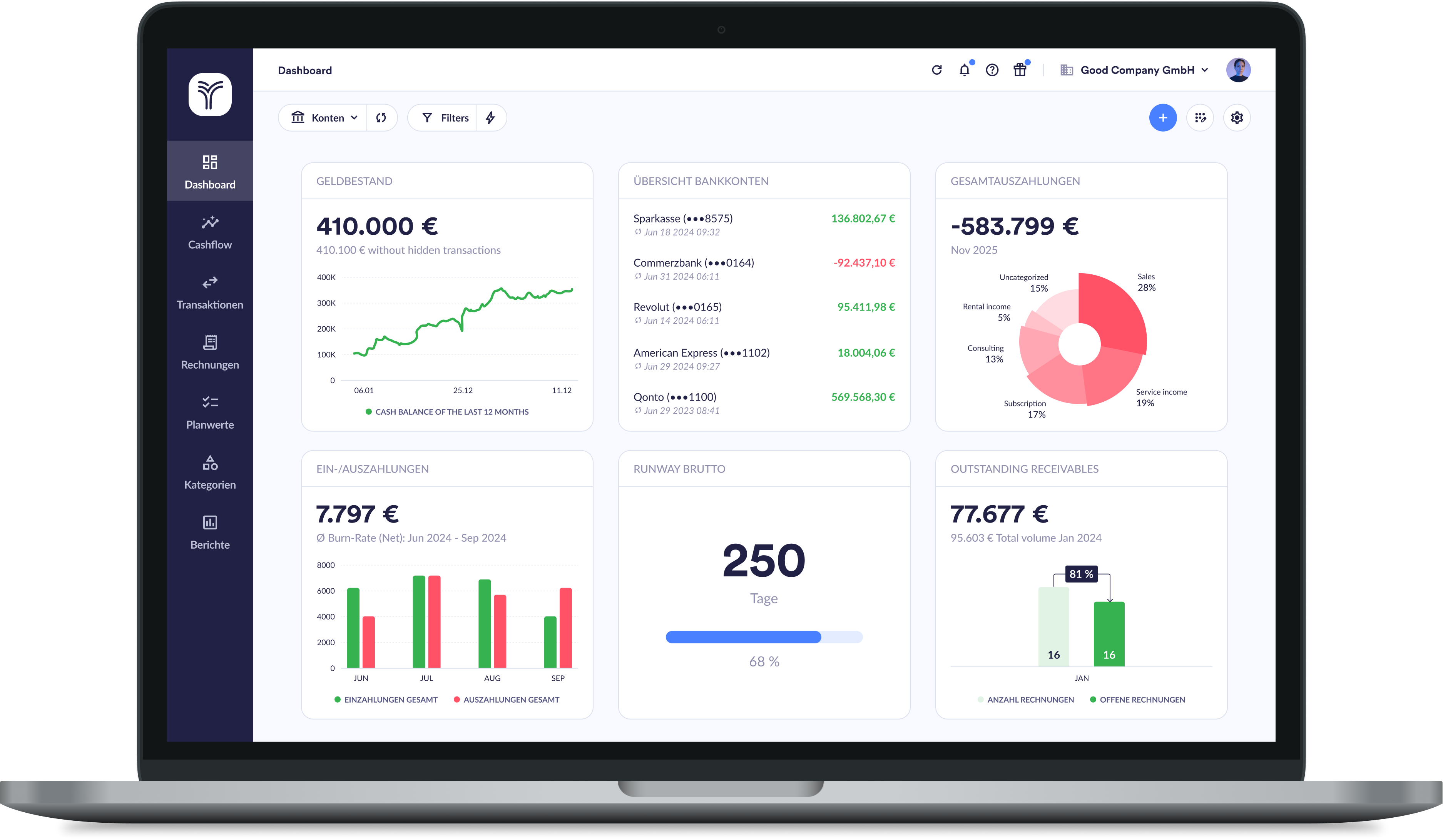
In software like Tidely, you connect your bank accounts and accounting system so that receivables, payables, and inventory are incorporated into your forecast in real time.
Using scenario analysis simulate in just a few clicks how a longer payment term, inventory reduction, or delayed incoming payment affects your liquidity (best, base, and worst-case scenarios). This turns a retrospective metric into a forward-looking management tool.
For a look at what structured liquidity management looks like in practice, check out the article Liquidity Management.
Try Tidely free for 7 days and see in real time how your working capital decisions impact future liquidity. No credit card required, get your first forecast in minutes. Start for free now
Conclusion
Working capital shows how well your company can cover its short-term obligations on its own. The formula is simple, but the art lies in the balance: enough of a buffer for security, with as little capital tied up as possible. By actively managing inventory, receivables, and payables and linking this metric to forward-looking liquidity planning, you transform working capital from a balance sheet figure into a real growth lever.
Frequently asked questions about working capital
What exactly is working capital?
Working capital is the difference between a company's current assets and its current liabilities. It indicates how much short-term capital is tied up in day-to-day operations and whether a company can pay its current bills using its own resources.
How do you calculate working capital?
You calculate working capital using the formula: current assets minus current liabilities. For example, if current assets are 150,000 euros and current liabilities are 90,000 euros, the working capital is 60,000 euros. You can find both figures directly on the balance sheet.
Is high or low working capital better?
Positive working capital is generally good because it means the company can cover its short-term debts. However, it shouldn't be too high, as that would mean too much capital is tied up in inventory and receivables, leaving it unavailable for more profitable purposes. The ideal is a balance—essentially, optimize rather than maximize.
What is working capital management?
Working capital management is the ongoing control of inventory, receivables, and payables. The goal is to achieve the shortest possible cash conversion cycle and minimize tied-up capital without jeopardizing your ability to deliver or pay.
What is the difference between net working capital and working capital?
In practice, both terms are usually used synonymously to mean current assets minus current liabilities. In a narrower definition, operating net working capital focuses only on core business—i.e., receivables plus inventory minus accounts payable—and excludes cash and financial debt.
What does working capital tell you?
Working capital indicates how stable a company's short-term financing is. A positive value means that current assets exceed short-term liabilities, providing a liquidity buffer. It also serves as an early warning indicator: declining working capital can point to rising inventory levels or slow payments.
What is a good working capital ratio?
At 100 percent, short-term liabilities are covered by current assets (Creditreform, 2025). Depending on the source, a range of around 130 to 200 percent is considered healthy (Controllingportal, n.d.). It is calculated by dividing current assets by current liabilities and multiplying by 100. Values significantly above 200 percent often indicate excessive inventory; the ideal value depends on the industry.
How can you improve working capital quickly?
The fastest way to improve working capital is to collect outstanding receivables promptly, reduce excess inventory, and negotiate fair, longer payment terms with suppliers. Together, these measures shorten the cash conversion cycle and free up tied-up capital. Financing instruments like factoring can bridge additional short-term needs.
Sources
1. Sparkasse: Working Capital, 2026
2. Gabler Wirtschaftslexikon: Working Capital, n.d.
3. KfW: KfW-Mittelstandspanel, 2025
4. DIHK: DIHK-Konjunkturumfrage Frühsommer 2025, 2025
5. Deutsche Bank: Working Capital. So behalten Sie Ihre Liquidität im Blick, n.d.
6. Allianz Trade: Working Capital. Definition und Bedeutung, n.d.
7. Creditreform: Working Capital Management, 2025
8. Grant Thornton: Working Capital in German SMEs, 2023
9. Controllingportal: Working Capital. Explanation and example calculation, n.d.
About the author
.jpg)
Niclas Storz is founder and CEO of Tidely, a B2B SaaS software solution for liquidity management for small and medium-sized companies. He previously worked as a management consultant for over 20 years. Most recently as Senior Partner & Managing Director at BCG.

.webp)