Liquidity Planning Software: The 10 Best Tools Compared 2026
Professional cash flow forecasting is not just about avoiding bottlenecks and insolvency – it is an essential instrument for sustainable business growth. Specialized cash flow forecasting software helps monitor cash flows in real time, identify financial risks early, and strategically secure investment decisions. While we at Tidely are providers of cash flow management software ourselves – and are convinced it is one of the best tools on the market – we also know that every company has different requirements. For this reason, we are providing you with the most objective comparison possible of the best cash flow forecasting software for 2026, so you can choose the solution that truly fits your business. We have researched the websites of various providers, read multiple comparison portals and reviews, and summarized our findings here. We hope you enjoy comparing!

Key takeaways
- Cash flow forecasting software answers a question that your account balance alone cannot: Will I remain solvent in the coming weeks and months? The focus is on projections, scenarios, and comparing planned versus actual figures. Such software is proven to save valuable time.
- Specialized planning tools like Tidely, Commitly, or finban provide more reliable projections than broad controlling and BI solutions like Board, Helu, Lucanet, or companyon, where planning is often just an add-on.
- Excel is fine as a free starting point, but becomes confusing as transaction volume grows: no real-time data, lots of manual work, and a high risk of error.
- What matters when choosing: quality of projections, scenario capabilities, planning horizon, integration with banks and accounting (such as DATEV), and onboarding support.
Jump straight to the tool comparison >
What is cash flow forecasting?
Cash flow forecasting means calculating future incoming and outgoing payments over a fixed period, usually weeks, months, or quarters. The goal is to remain solvent in the long term, identify bottlenecks early, and use available funds effectively. This is exactly where cash flow forecasting software comes in, automating these projections and keeping them up to date.
In practice, three terms are often used interchangeably, even though they cover different time horizons. Cash flow management is the most short-term approach: It keeps an eye on daily payments and ensures that the account remains covered for day-to-day operations.
The cash flow forecast builds on this and looks ahead by predicting the future development of your cash flows. It is therefore the foundation upon which every major financial decision rests.
Finally, cash flow management thinks furthest ahead and encompasses the long-term strategy for securing solvency, for example through credit lines, payment terms, or receivables management.
If you are primarily concerned with the daily management of your cash flows, take a look at our cash flow software comparison. This article is dedicated to forward-looking planning.
What matters: It is not the product name that counts, but the focus. Does the tool actively plan and manage future liquidity, or does it primarily analyze past figures and controlling KPIs? In the latter case, the planning function is often just an extra and correspondingly superficial.
Why use cash flow forecasting software instead of Excel?
As long as there are only a few items to track, financial planning can be managed in Excel. However, with every additional account, customer, or employee, the maintenance effort grows: figures must be entered manually, account balances lag behind, and the forecast is only as reliable as the last manual entry.
Cash flow forecasting software handles this maintenance automatically: it pulls in bank and accounting data, updates the forecast, and allows you to run scenarios at the click of a button.
A survey of 125 Tidely users shows the practical benefits: nearly three-quarters work on their planning at least weekly, and with Tidely, the time required for this is reduced by about half on average, saving around four hours per week.
Key features of modern cash flow forecasting software
Whether a tool can actually plan or just collects numbers comes down to these six points:
Reliable projections. The forecast should be generated from your actual cash flows and update automatically, rather than relying on static assumptions.
Running scenarios. A good tool shows what happens if a major customer pays late or an investment is brought forward. More on this in our article on scenario planning and forecasting.
Plan vs. actual. Only by continuously comparing your plan with actual performance can you identify deviations—ideally on a daily, weekly, and monthly basis.
Planning horizon and level of detail. Depending on your business, you may need daily short-term planning or rolling forecasts covering several months. Your tool should be capable of both.
Automated data foundation. A bank connection as well as integration with accounting and ERP systems like DATEV, Lexoffice, or sevDesk keeps your planning up to date and saves you from manual data entry.
Clear presentation and reporting. Easy-to-understand views and exportable reports are essential whenever banks, investors, or tax advisors need to review your planning.
The 10 best cash flow management software solutions compared
Cash flow management software must fit your company's size, workflow, and budget. We have evaluated the following ten solutions for 2026 specifically from a planning perspective, including current OMR ratings (as of June 2026), pricing, and their respective strengths and weaknesses.

1. Tidely
⭐️⭐️⭐️⭐️⭐️ 4.5 / 5
144 reviews on OMR
Price: From €45.00 / month
Demo: Yes, 1:1 product presentation
Free trial access without credit card: 7 days
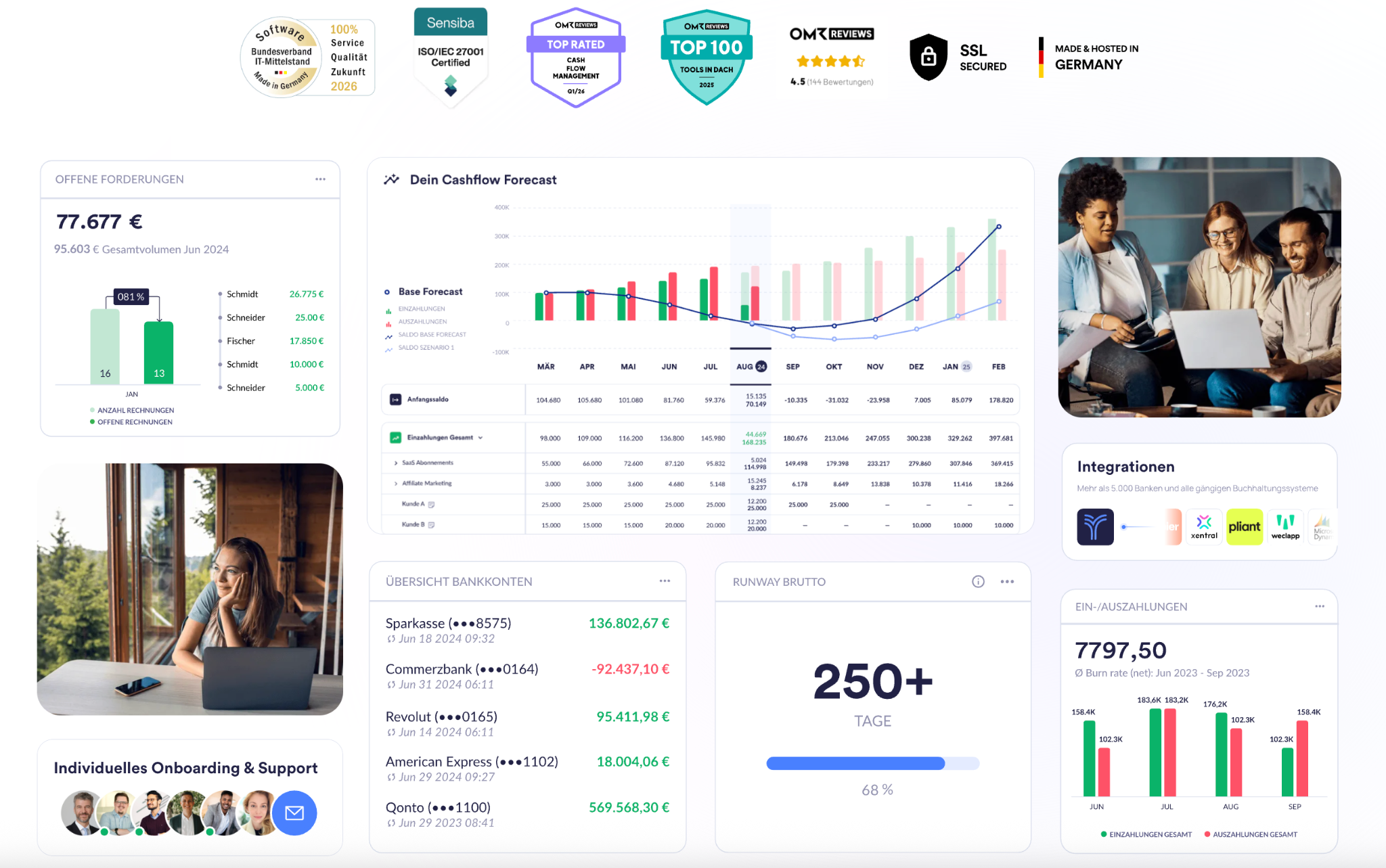
Tidely is based in Germany and was built specifically for the cash flow planning needs of SMEs, start-ups, and scale-ups. Instead of just displaying balances, the tool generates a forward-looking cash flow forecast and keeps it automatically updated via more than 5,000 banks as well as accounting and ERP systems like DATEV, Lexoffice, and sevDesk. Around 1,500 companies already use it to plan their solvency.
Best suited for: Teams that want to plan their liquidity proactively and test scenarios without a lengthy implementation project.
Tidely's strengths:
- AI onboarding and forecasting in 15 minutes. Tidely synchronizes your transactions, our AI automatically sorts them into a clean category tree, identifies trends in your historical cash flows, and suggests plan values for the next 24 months based on the last 12 months—including seasonality if desired.
- One-click scenarios. You can simulate delayed payments, a new hire, or an early investment and immediately see the effect on future liquidity.
- Automated data foundation including DATEV. In addition to the new DATEV integration, Tidely connects with Lexoffice, sevDesk, Xentral, Weclapp, Moco, easybill, and Microsoft Dynamics 365 BC, as well as PayPal, EBICS, an open API, and Zapier. AI pre-sorts bookings, minimizing the effort required to maintain your plan.
- 13-week planning at the push of a button. The 13-week plan is the standard that banks, investors, and advisory boards want to see for short-term liquidity proof. It shows you exactly how your liquidity will develop over the next three months, updated on a rolling basis with your real-time data.
- Plan vs. actual comparison with variance analysis. See plan and actuals at a glance; deviations are identified before they become problems. What is one of the most difficult tasks in Excel takes only seconds in Tidely.
- Team collaboration and notes. Coordinate, comment, and record assumptions directly within the plan without overwriting your colleagues' work.
- Made in Germany, verified secure. Development and hosting in Germany, GDPR-compliant, and ISO/IEC 27001 certified.
- Guided support, not self-service. Personal onboarding (1:1 for Business plans) plus support via phone, chat, and email.
Tidely's weaknesses:
- European focus. The bank integration primarily covers European institutions. Companies working predominantly with US or Asian accounts might find better coverage with local providers. However, for cash flow planning in the DACH region and Europe, the integration is broadly positioned.
- Accounting interfaces from Professional tier. The Starter plan does not yet include the accounting interface (including DATEV integration). If you want to incorporate accounting data into your cash flow planning from the start, you will need to move up one tier; the integration is fully available starting with the Professional plan.
Tidely pricing
Tidely offers four packages:
- Starter from €45 / month: 1 bank account, with AI categorization and AI cash flow forecasting, 3 KPI widgets & live group onboarding
- Professional from €85 / month: 5 bank accounts, accounting integration, 2 team members, live group onboarding
- Business from €215 / month: 10 bank accounts, up to 3 companies, 5 team members, and personalized live onboarding
- Enterprise available upon request for large corporate structures with an unlimited number of accounts, companies, and a dedicated consultant.
Pricing is transparent with no hidden extra costs. A free 7-day trial is available, with no credit card required.
What our customers say

2. Commitly
⭐️⭐️⭐️⭐️⭐️ 4.8 / 5
140 reviews on OMR
Price: From €45.00 / month
Demo: No
Free trial: 14 days
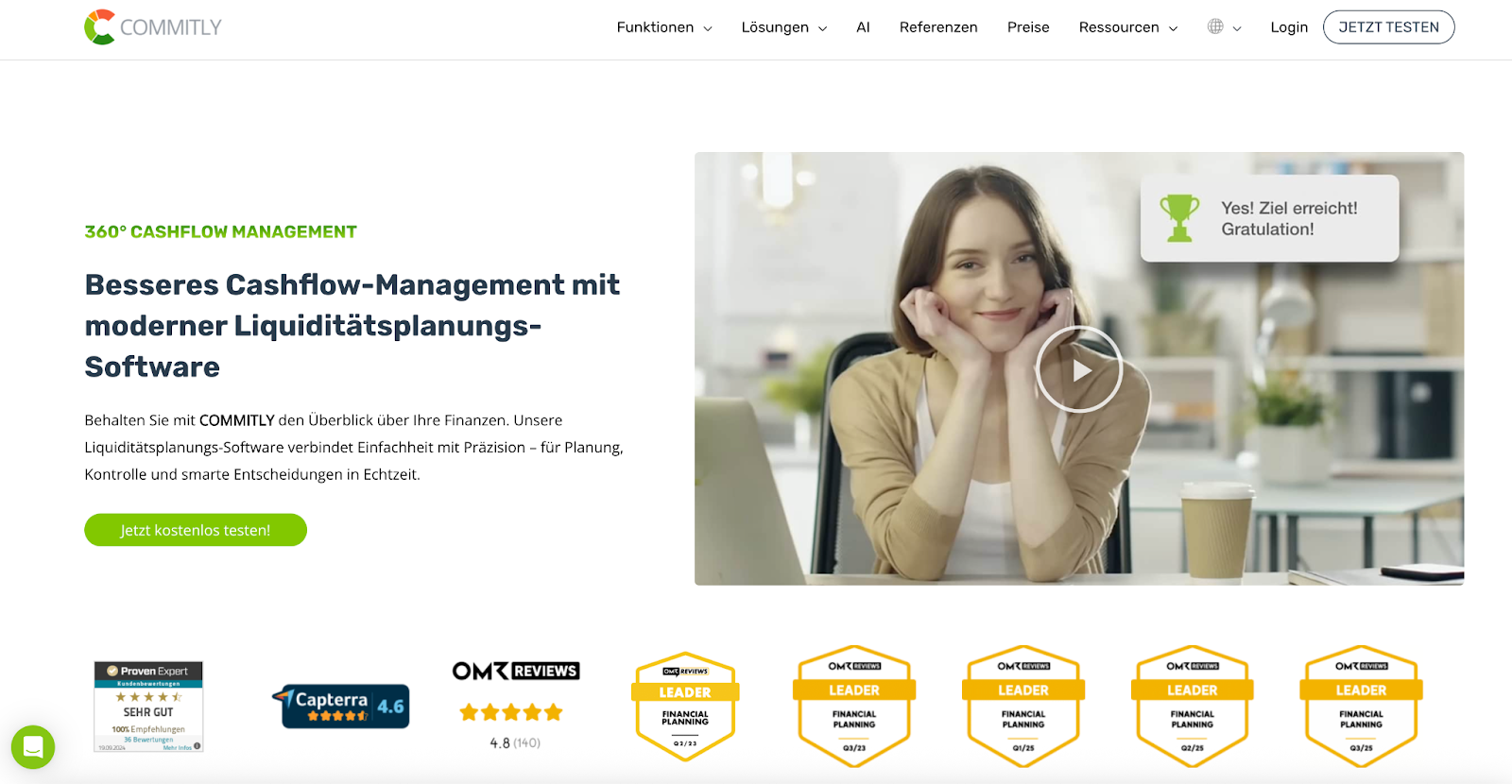
Commitly is based in Germany and Austria and is tailored to cash flow planning for SMEs and finance-savvy users. The software focuses on automated previews and a deliberately streamlined feature set.
Suitable for: Users with controlling experience in the DACH region who appreciate focused planning and do not require a personal introduction.
Commitly's strengths:
- Bank connectivity in the DACH region. More than 3,000 institutions in Germany and Austria are connected, ranging from Sparkassen and Volksbanken to Commerzbank, Deutsche Bank, and ING. Access is read-only; payment initiation is not possible.
- Open items with "Commitly Bills". Through this add-on module, liabilities and open incoming invoices, including approval processes and an audit trail, flow directly into your planning.
- Forecasts and plan variants. Various scenarios can be simulated, forecasts calculated automatically, and compared against actual performance. You can create plan variants in just a few clicks, using either percentage-based or absolute projections for future periods.
Commitly's drawbacks:
- Limited accounting integrations. Reviews on Capterra often point out the limited number of connections to accounting systems. This makes Commitly less flexible than cash flow software with broader ERP integration.
- No personal onboarding. There is no 1:1 introduction. If you need guidance when getting started, you will notice the difference compared to Tidely, which offers personal onboarding by an expert starting from the Professional plan.
What Commitly costs
Entry-level pricing starts at €45.83 per month (billed annually) and is spread across the three packages: Basis, Business, and Professional. For a comparable starting price, Tidely provides personal onboarding, over 5,000 bank connections, and a wider selection of integrations.
Recommended reading: Tidely as a Commitly alternative
3. Agicap
⭐️⭐️⭐️⭐️⭐️ 4.6 / 5
169 reviews on OMR
Price: Upon request
Demo: Yes
Free trial: Yes
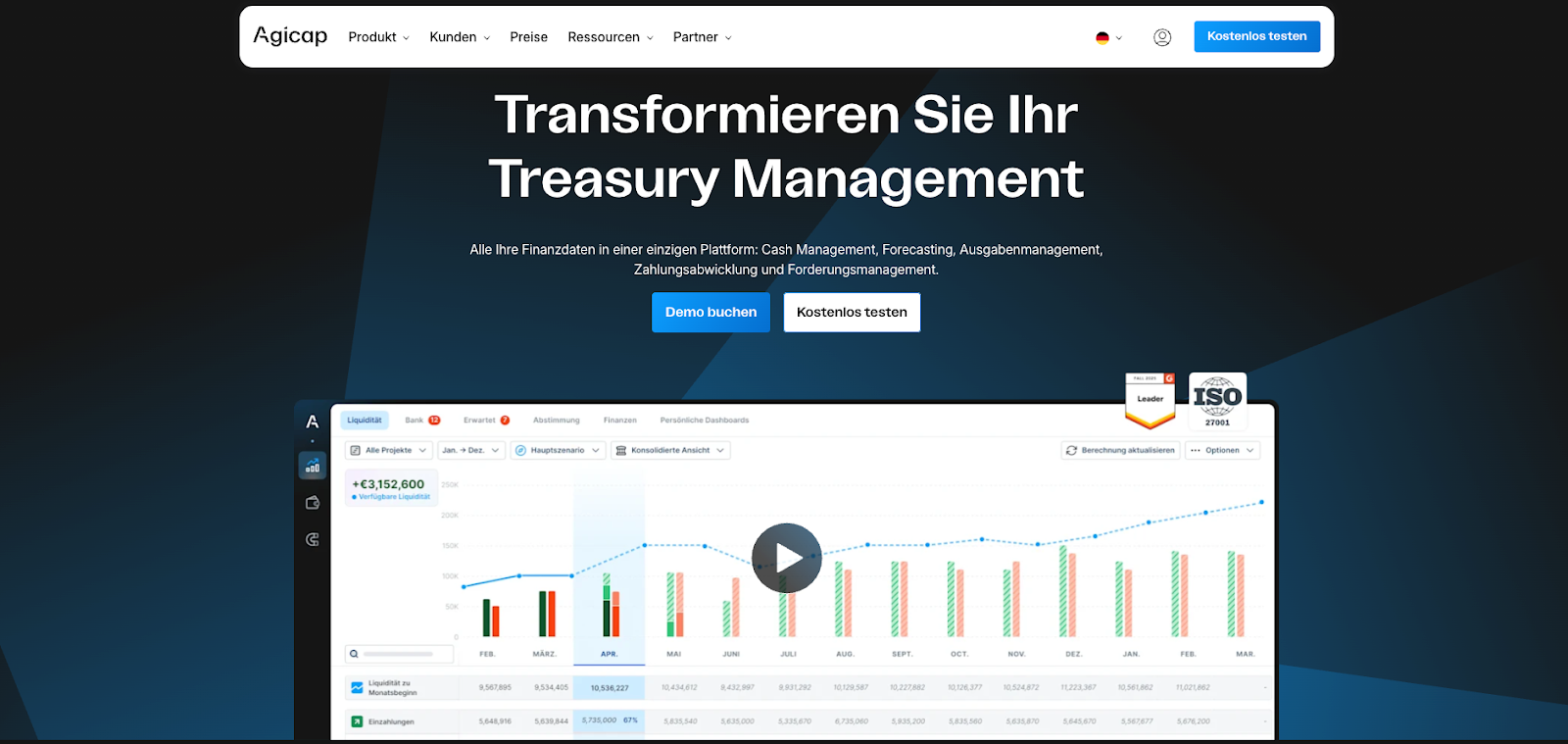
Agicap is a French provider well-established in the European market for financial and liquidity management. Its cash flow forecasting software is tailored to mid-sized companies and groups with multiple entities, bank accounts, or currencies. At its core, it combines real-time liquidity overviews with automated categorization, scenario planning, and a consolidated view across all business units.
Agicap's strengths:
- Rolling forecasts across all levels. 13-week forecasts and longer-term, daily-accurate projections can be modeled flexibly, including variance analysis at the group, department, or individual entity level directly within the dashboard.
- Consolidated group planning. For multi-entity structures, you can switch between the group-wide view and individual unit details with a single click, while keeping the consolidated liquidity forecast in view at all times.
- Extensive feature set for complex structures. Beyond basic planning, it includes modules for dunning (CashCollect), expense management, cash pooling, and AR/AP automation—ideal for companies looking to consolidate their entire treasury management into one tool.
Agicap's weaknesses:
- Additional features drive up the price. Features like dunning or expense management are separate modules. Users who utilize the full suite pay accordingly; recent reviews (Capterra and G2, 2026) report total annual costs of €3,000 or more.
- High barrier to entry for small businesses. The liquidity tool is designed for mid-sized companies with dedicated finance teams. For SMEs without finance specialists, the feature set can quickly become overwhelming and the price difficult to justify, a sentiment frequently echoed in user reviews on Capterra, G2, and GetApp.
Agicap pricing
Pricing is available only upon request and is based on individual needs. It sits in the premium segment, which can be a significant hurdle for smaller companies or start-ups. Furthermore, many features must be added as paid modules or add-ons.
Recommended reading: Tidely as an Agicap alternative

4. Microsoft Excel
⭐️⭐️⭐️⭐️⭐️ 4.5 / 5
142 reviews on OMR
Price: from €5.60 / month
Demo: No
Free trial: Yes, 1 month
Microsoft Excel is one of the most well-known spreadsheet programs and has been used for decades for financial planning, analysis, and calculations. Many companies also use it for liquidity planning. It allows for the manual entry of income and expenses, the creation of forecasts, and cash flow analysis. However, using Excel for liquidity planning comes with several challenges.
Microsoft Excel's strengths:
- Flexibility and adaptability: Excel can be customized for various financial processes. Users can utilize formulas, pivot tables, and charts to manage financial data manually.
- Widespread use and compatibility: Seamless integration with other Microsoft products like Word, PowerPoint, and Teams facilitates collaboration. Furthermore, Excel is widely used, meaning many companies are already familiar with the tool.
- Affordable pricing structure: Compared to specialized cash flow planning software, Excel is often a more cost-effective solution.
Weaknesses of Microsoft Excel:
- High manual effort: Data maintenance requires regular manual updates, which is time-consuming and prone to errors. A lack of automation hinders efficient and dynamic cash flow planning.
- No real-time overview: Financial data must be updated by hand, and automatic synchronization with bank accounts or accounting systems is not possible. This complicates planning and requires constant manual adjustments.
- Lack of automation and susceptibility to errors: Unlike specialized cash flow management tools, Excel does not offer integrated functions for automatic forecasting or simulations of liquidity trends. Additionally, the multitude of manual processes can easily lead to formula or entry errors that distort the entire financial plan.
What Microsoft Excel costs:
Excel can be purchased as a standalone product for €159 or used as part of a Microsoft 365 subscription. Prices vary depending on the features included: the most affordable version – Microsoft 365 Business Basic – is available from €5.60 per month (billed annually).
Read more: Excel template for cash flow planning


5. Helu
⭐️⭐️⭐️⭐️⭐️ 4.5 / 5
52 reviews on OMR
Price: Upon request
Demo: No
Free trial: Yes
Helu is aimed at CFOs and finance managers in SMEs and scale-ups who no longer view finance as a purely administrative function, but as an active lever for corporate management. It is not a classic liquidity tool. Instead, Helu acts as an add-on layer: sitting between DATEV, operational sources like HR or CRM, and management, the platform ensures that numbers are transformed into reliable foundations for decision-making. It does not replace tools like Tidely or Commitly, but rather complements them.
Strengths of Helu:
- Forward-looking management instead of looking back. Instead of producing reports on the past, Helu bundles hard and soft metrics into one model, allows for the calculation of various planning scenarios, and keeps all stakeholders on the same page. The back-and-forth between multiple spreadsheet versions is eliminated.
- Metrics that fit the business. Those who want to derive their own management metrics from areas like HR, sales, or CRM can connect these drivers in a shared model. This creates KPIs that reflect real processes within the company rather than just standard values.
- Reporting without manual work thanks to DATEV. Using the official interface in the DATEV marketplace, Helu automatically pulls accounting figures and recalculates reports after every upload. P&L, balance sheets, cash flow analyses, and cost centers are therefore available without manual maintenance.
Weaknesses of Helu:
- Interface not always completely stable. Occasionally, users report that the DATEV synchronization drops out. The stability of the connection is being continuously improved.
- Not for daily liquidity management. Helu intentionally does not cover the operational side. For daily account balances and short-term forecasts, a specialized solution like Tidely is still required.
What Helu costs
Helu does not provide a fixed list price. Instead, a custom quote is calculated for each company based on their specific needs. Those interested in getting started can request this individual package directly from the provider.


6. Lucanet
⭐️⭐️⭐️⭐️⭐️ 4.3 / 5
11 reviews on OMR
Price: Upon request
Demo: Yes
Free trial: No
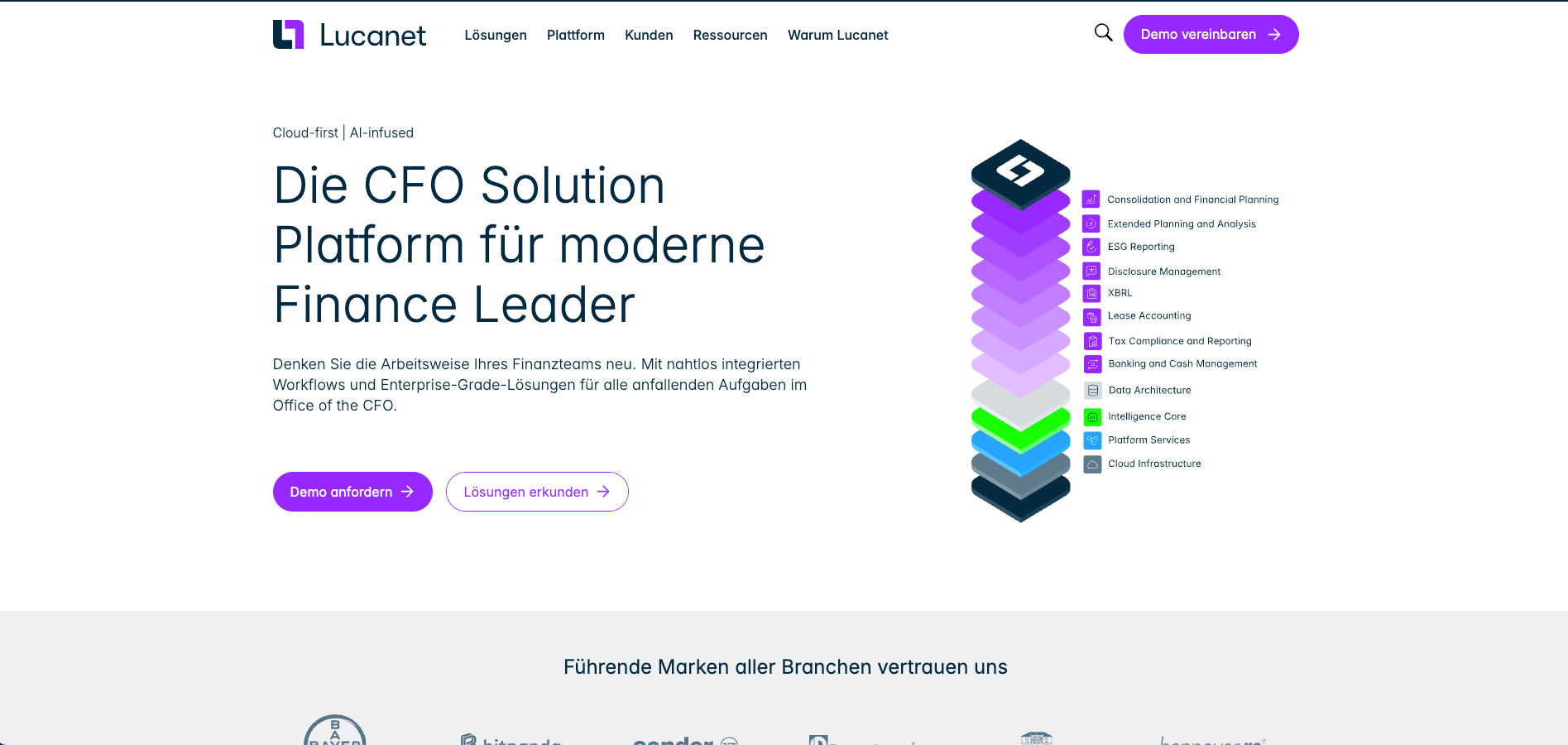
Lucanet is financial software that supports CFOs and finance teams with the planning, consolidation, and reporting of their financial data. The solution is primarily aimed at medium-sized and large companies that require a central platform for their financial processes.
Suitable for which planning needs: Organizations with consolidation and reporting requirements where liquidity planning is part of a larger financial process.
Strengths of Lucanet:
- Efficient financial reporting: Lucanet enables the structured and automated creation of financial reports, including budgeting, variance analysis, and forecasting. Thanks to an intuitive user interface, even users without deep IT knowledge can quickly use the software.
- High flexibility in data integration: Lucanet allows for versatile connections to various accounting and ERP systems, including SAP S/4HANA. Companies can flexibly import and process financial data, which facilitates detailed and customized financial analysis.
- Comprehensive forecasting: Lucanet offers dynamic planning functions that allow companies to simulate scenarios, evaluate investments, and identify financial risks at an early stage.
Weaknesses of Lucanet:
- Planning functions have room for improvement. Lucanet originated in consolidation. Even in 2026, users still cite planning and forecasting functions as the area with the greatest need for improvement, and the logic behind balance sheet planning is not always immediately apparent. For a tool intended to excel in liquidity planning, this is a sore point.
- High price point. In recent user surveys, about a third cite rising costs as a problem. Smaller companies, in particular, find Lucanet expensive in relation to the required scope of functions.
What Lucanet costs
Lucanet offers Basic, Advanced, and Professional packages, which differ in their scope of functions and support. Prices are individually customizable and available only upon request.

7. TRESIO
⭐️⭐️⭐️⭐️⭐️ 4 / 5
3 reviews on Trustpilot (not listed on OMR)
Price: From 35.00 CHF/month
Demo: Onboarding service
Free trial: Yes
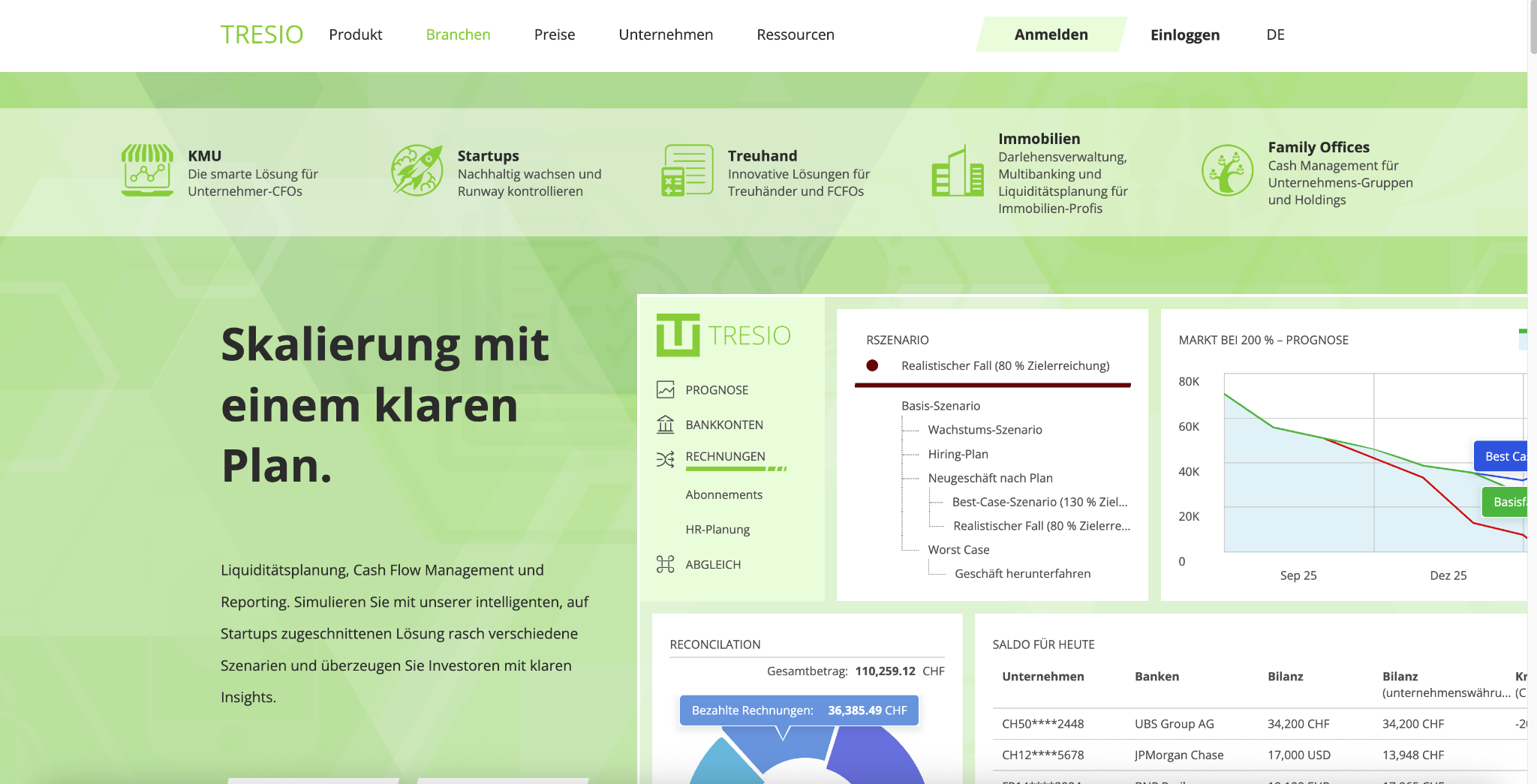
Tresio is liquidity management software from Switzerland that is particularly suitable for companies with Swiss bank accounts and supports the analysis and forecasting of cash flow. The software enables seamless integration of bank accounts as well as connections to several accounting systems. A multi-banking function ensures that all relevant account movements are visible in one place – even across multiple currencies.
TRESIO strengths:
- Comprehensive scenario planning: TRESIO allows you to create and compare "what-if" scenarios to evaluate the financial impact of various business decisions—such as cost-cutting measures or new hires—in advance.
- Centralized bank connectivity: The liquidity planning tool offers a multi-banking interface to provide a daily overview of all transactions and balances, including those in different currencies and cryptocurrencies.
- Flexible data import: TRESIO enables the import of financial data via both API integrations and manual file uploads (CSV, Excel, FTP). This allows companies to connect their accounting systems with ease.
TRESIO weaknesses:
- Data import primarily via accounting. TRESIO typically pulls its data through connected accounting software (such as bexio or Abacus). This means more setup effort, and direct bank connectivity requires additional interfaces.
- Strong DACH and Swiss focus. Bank connections and accounting integrations are geared toward the DACH region and Switzerland. Those operating outside this region or using different accounting systems will find fewer ready-made integrations.
- Low visibility and limited review base. Compared to Agicap or Tidely, TRESIO is less well-known in Germany, and there are few independent reviews available. This makes it harder to assess before purchasing.
TRESIO pricing
TRESIO offers various pricing models based on company size and feature set. Packages start at 35 CHF per month when billed annually. All three packages include an onboarding service.

8. finban.io
⭐️⭐️⭐️⭐️⭐️ 4.8 / 5
17 reviews on OMR
Price: From €26.25/month
Demo: Yes
Free trial: Yes, 14 days
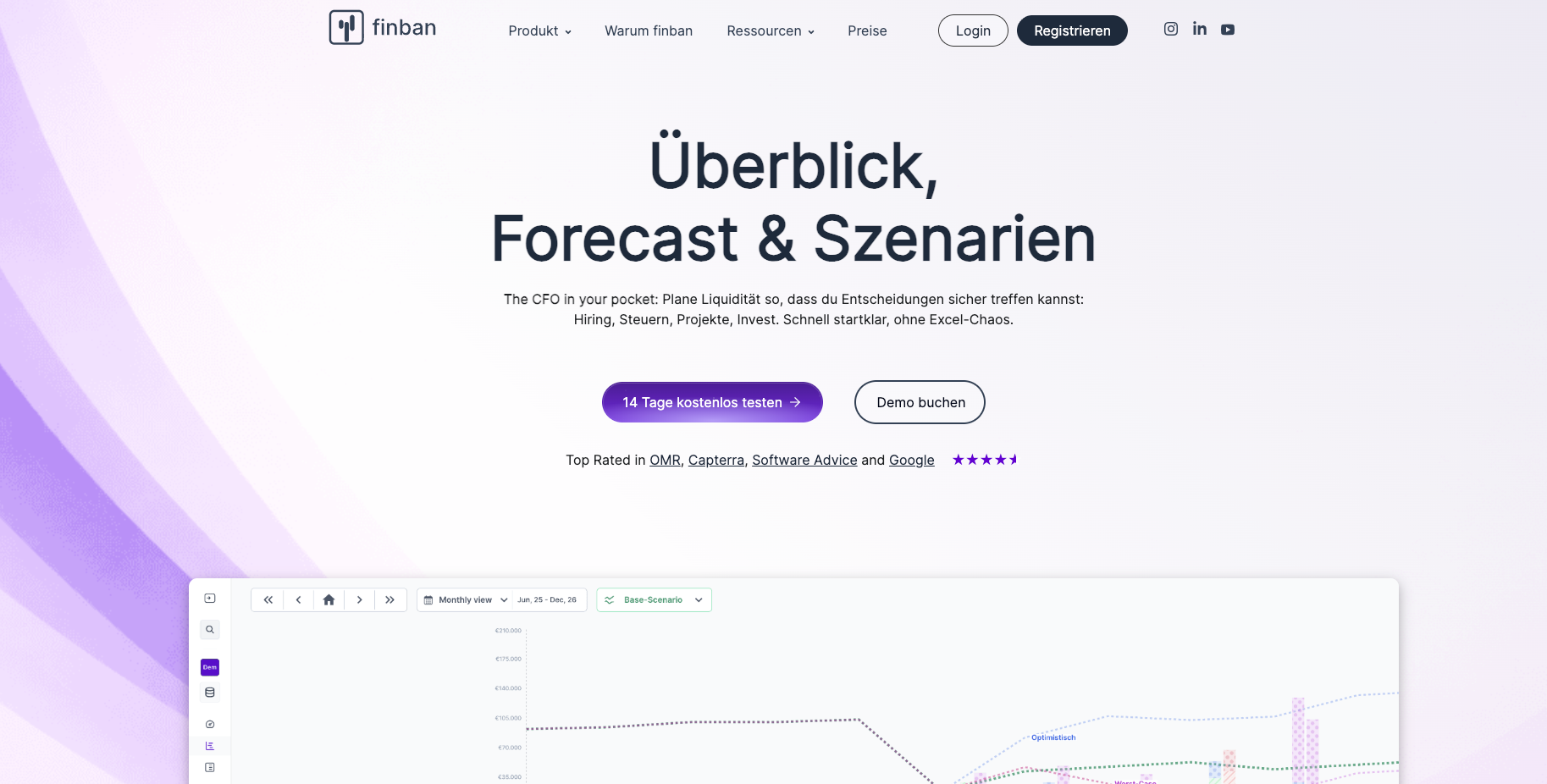
Launched in 2023, finban is a financial planning solution specifically tailored for SMEs, start-ups, agencies, and SaaS companies. With real-time cash flow forecasts, testable scenarios, and connectivity for bank accounts and accounting tools, finban positions itself as a modern alternative to traditional Excel spreadsheets.
finban strengths:
- Flexible scenario modeling. Various financial scenarios can be created and compared, making it immediately clear how an investment, a new hire, or a payment default affects liquidity.
- Lowest barrier to entry in the field. The Starter package is €26.25 per month, making it the most affordable specialized entry point in this overview. It is an attractive starting point for solo entrepreneurs and micro-businesses with one bank account and one accounting system.
- Data securely hosted in Europe. finban stores data on AWS servers within Europe and complies with GDPR requirements as well as the ISO/IEC 27001:2013 standard.
finban weaknesses:
- Limited ERP connectivity. Interfaces to common ERP systems are currently limited, which complicates automatic reconciliation with accounting. In recent 2026 user reviews on OMR Reviews and Capterra, users have expressed a desire for more integrations.
- No automatic categorization. Unlike Tidely, there is no automatic transaction categorization based on rules. Transactions must be sorted manually, which becomes increasingly time-consuming as the number of transactions grows. Reviewers also criticize the inflexible category logic—such as the lack of custom categories per organization—as well as occasional delays in bank synchronization (OMR Reviews and Capterra, 2026).
finban pricing
finban offers four packages with annual billing: Starter from €26.25 per month (1 bank account, 1 organization, 1 user), Business from €48.75 per month (5 bank accounts, 5 users), Pro from €90 per month (10 bank accounts, 5 organizations, 10 users), and Custom upon request for complex structures and family offices.

9. companyon
⭐️⭐️⭐️⭐️⭐️ 4.9 / 5
7 reviews on OMR
Price: From €69.00/month
Demo: Yes
Free trial: Yes, 14 days
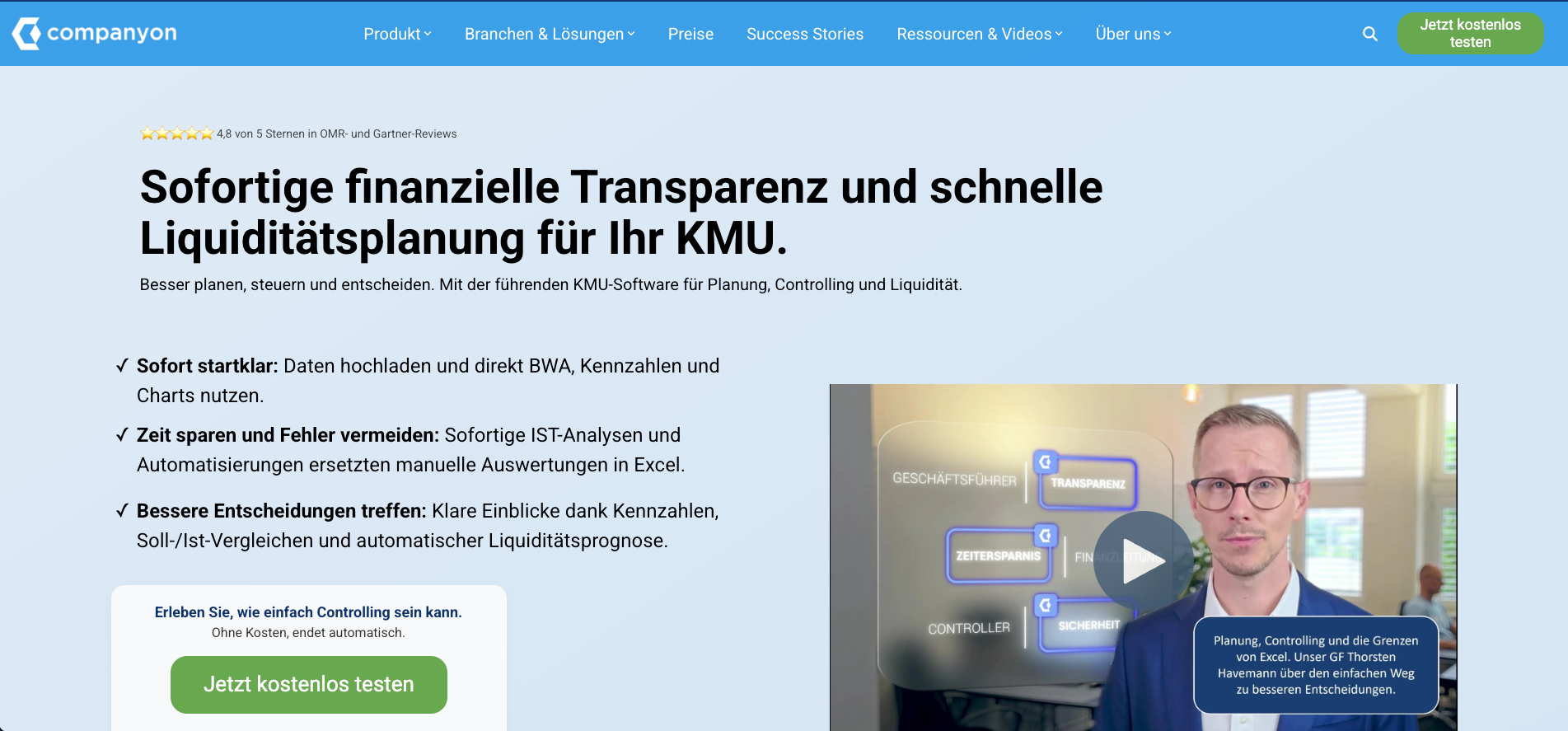
companyon is a controlling solution for SMEs that bundles several tasks under one roof: planning, budgeting, BWA (business analysis), KPI evaluation, and liquidity forecasting. As with Helu, the focus is on strategic controlling rather than real-time operational liquidity management. The tool can be set up in just a few minutes. Accounting figures are uploaded to the system via file upload; there is no direct DATEV integration.
Strengths of companyon:
- Automatic liquidity forecasting based on actual and planned data. Using the uploaded accounting and planning figures, companyon independently derives liquidity previews as well as earnings and cash flow forecasts, supplemented by scenarios and target-actual comparisons.
- Multiple entities in one view. For those working with branches, subsidiaries, or holdings, all units can be combined with a single click to receive a consolidated report, including an overall liquidity forecast.
- Ready to go without an implementation project. As soon as the accounting data is uploaded, liquidity planning runs immediately. Reports, BWA, and KPIs are generated automatically, eliminating the need for manual setup.
Weaknesses of companyon:
- No open API. companyon does not offer an API for connecting your own systems. Data flow is handled via designated imports rather than custom integrations (OMR Reviews and Capterra, 2026).
- Limited customization for complex structures. According to recent OMR and Capterra reviews, those looking to map nested corporate or holding structures will hit limits regarding customization options. Additionally, there is no mobile app; reports are only available in the browser.
What companyon costs
companyon offers four packages: Basic from €69/month, Professional from €109/month, Expert from €179/month (all excl. VAT, billed annually), and Premium upon request. A 14-day free trial is available.

10. Board
⭐️⭐️⭐️⭐️⭐️ 4.7 / 5
30 reviews on OMR
Price: Upon request
Demo: Yes
Free trial: No
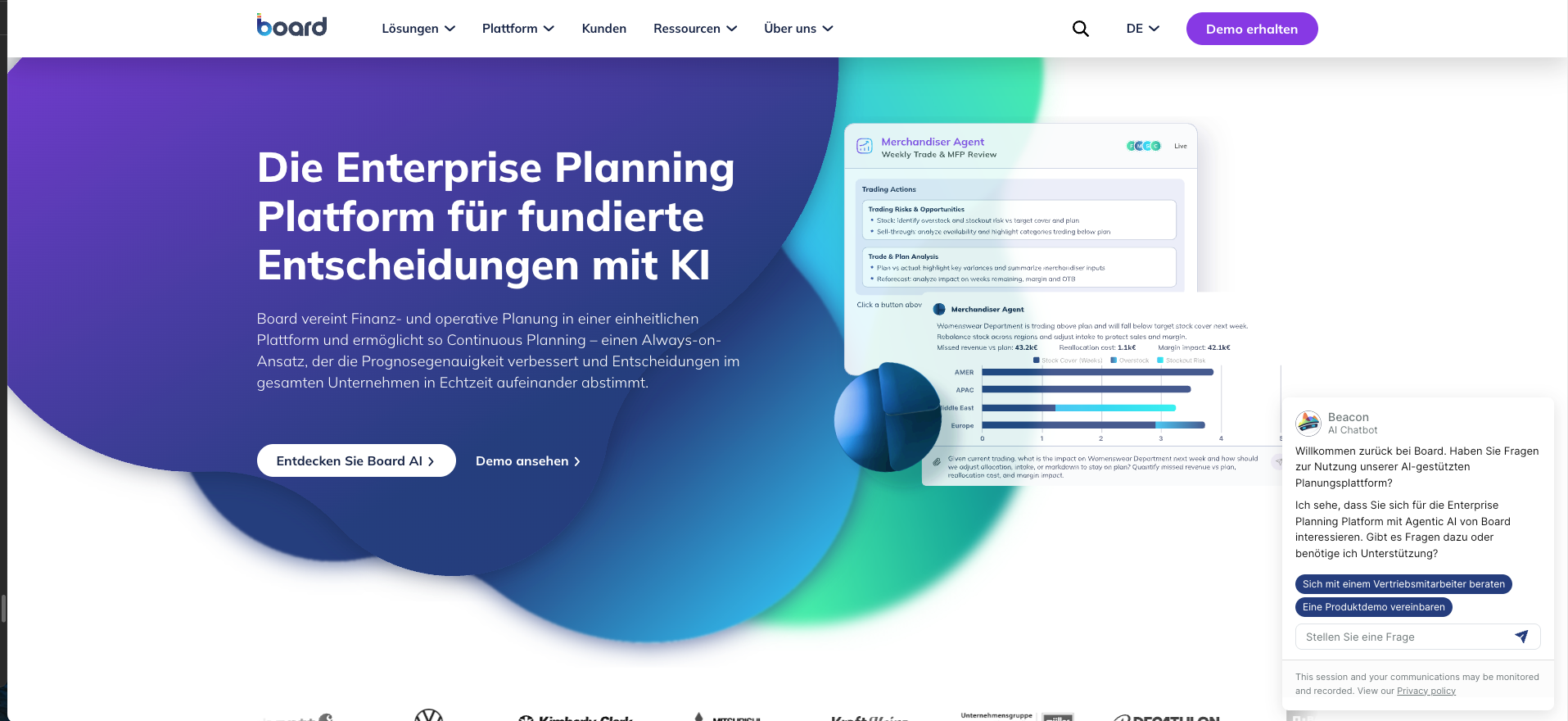
Board is an enterprise planning platform from Switzerland that combines business intelligence, corporate performance management, and predictive analytics under one roof. It primarily targets medium-sized and large companies in sectors such as retail, manufacturing, or financial services that want to centrally consolidate their complex planning and analysis processes. Liquidity planning is just one component within a much broader FP&A framework; therefore, Board does not replace specialized liquidity planning software.
Strengths of Board:
- A consolidated data foundation. Board connects to SAP, Salesforce, Microsoft, and other ERP and CRM systems, merging their data into a single, reliable source. This data foundation serves as the basis for robust forecasts and a consolidated liquidity projection across multiple entities.
- All disciplines in one system. Reporting, dashboards, scenario simulation, forecasting, and planning run without the need for multiple separate tools. Especially in complex structures, this eliminates the constant reconciliation of data between different systems, simplifying strategic liquidity planning at the group level.
Weaknesses of Board:
- No real-time operational liquidity management. Board is designed as a strategic analysis and planning platform, not as an ongoing liquidity tool. For daily account balances, automatic bank integration, and operational, short-term liquidity planning, Tidely is the more suitable choice. Current reviews clearly position Board in the strategic enterprise segment (G2 and Gartner Peer Insights, 2026).
- Complex onboarding with a noticeable learning curve. The initial setup is considered complex and rarely succeeds without external consulting. Users reported in 2026 that administrators, in particular, need time for data modeling and configuration, and performance can lag with very large data volumes. For SMEs simply looking for a lean liquidity planning tool, the effort is often too high (G2 and Gartner Peer Insights, 2026).
What Board costs
Board does not publish public pricing; costs are negotiated individually. Since the platform is tailored to medium-sized to large companies, the cost structure generally does not make sense for smaller businesses.
Which liquidity tool is suitable for which company size and industry?
Which liquidity planning software is the right one depends primarily on size, structure, and industry. As a guide:
- SMEs, start-ups, and mid-sized companies: Tidely, Commitly, or finban are quick to set up, cover operational, daily liquidity planning, and offer good value for money. Ideal if you are looking for a lean liquidity tool without a lengthy implementation project.
- Large companies and corporations: Agicap, Lucanet, or Board play to their strengths in consolidation, scenario analysis, and consolidated liquidity forecasting across many entities, but require a dedicated finance or controlling team.
- Project-based business: Those setting up liquidity planning around individual projects need scenario-capable tools that map cash inflows and outflows per project. How liquidity planning in project-based business can be managed is something we demonstrate on the relevant industry page.
- Industry logic: Seasonal fluctuations, payment terms, and pre-financing differ significantly by industry. In retail and e-commerce, seasons and inventory cycles drive planning; in agencies and project-based businesses, it is project milestones; and in the hospitality industry, it is pronounced seasonality.
Relevant industry pages with practical examples of liquidity planning: E-commerce, agencies, retail, hospitality, project-based business, start-ups.
3 tips: How to find the right liquidity planning software
Which tool suits you depends on your specific requirements and your company's needs. There is no single perfect liquidity planning software for everyone. It is helpful to clarify the basics beforehand: Anyone who knows how to calculate their own liquidity will more quickly recognize which functions a software really needs to cover. To make your selection easier, these three guiding questions will help:
1. Clarify what the tool should primarily achieve
If you are looking for daily liquidity planning, testable scenarios, and a real-time view of your cash flows, specialized liquidity tools like Tidely, Commitly, or finban are the obvious choice. Such solutions are designed to make impending bottlenecks visible early on and allow for short-term countermeasures.
If, on the other hand, you need a broadly positioned financial plan that covers controlling, accounting, or budgeting in addition to liquidity forecasting, Lucanet, Helu, or companyon are worth a look. They provide additional modules for performance analysis and planning, but usually map operational liquidity management less deeply than a tool focused specifically on that.
2. Align with your company size
What liquidity management software needs to be able to do shifts with the size of the company. For SMEs, start-ups, and scale-ups, lean solutions like Tidely, Commitly, or finban are a good fit because they can be set up quickly, are easy to use without long training, and remain predictable in terms of price.
Larger companies and groups that require functions beyond pure liquidity planning, such as cash pooling, dunning, consolidation, or credit management, will find more powerful—but also more complex and expensive—alternatives in Agicap, Lucanet, or Board.
3. Pay attention to support and guidance during the start
Especially when setting up liquidity planning for the first time, the level of support determines how quickly you become productive. Tidely focuses on personal onboarding, accessible support via chat, email, and—depending on the package—phone, supplemented by video tutorials and an extensive knowledge base.
Agicap is also praised in reviews for its responsive support, while providers like Commitly or finban rely more on self-service via knowledge bases and digital help. This way, you can find the right tool based on your desired level of support, even without your own finance team.
Conclusion: Which cash flow forecasting software is right for you?
The ten tools in this comparison serve very different planning needs. The deciding factor is not the range of features itself, but how deeply a solution actually masters forward-looking cash flow forecasting. The most important recommendations at a glance:
Tidely is the best choice for SMEs, start-ups, and scale-ups looking for specialized cash flow forecasting with daily updates, scenario planning, and plan-vs-actual comparisons, without a lengthy implementation project. AI categorization and automated cash flow forecasting are included starting with the Starter package, and the DATEV integration is available from the Professional plan onwards.
Commitly is a streamlined alternative for finance-savvy users in the DACH region with strong bank connectivity, but it offers fewer accounting integrations and no personal onboarding.
Agicap is aimed at mid-sized companies and groups with multiple entities and their own finance team that need consolidated cash flow planning across many units and have a larger budget.
finban is the most affordable specialized entry-level option and is ideal for solo entrepreneurs, agencies, and micro-enterprises with simple structures.
Microsoft Excel is only suitable as a free starting point for very simple cases, without real-time data and with a high maintenance effort.
Helu and companyon are less about cash flow tools and more about FP&A and controlling solutions. They complement specialized planning but do not replace operational cash flow management.
Lucanet and Board are designed for consolidation, reporting, and strategic enterprise planning. They are over-engineered for short-term, operational cash flow forecasting.
TRESIO is particularly interesting for companies with Swiss bank accounts and a focus on the DACH region.
If you are looking for a user-friendly, transparently priced solution specifically for forward-looking cash flow forecasting, where you won't be left on your own when getting started, Tidely is the right choice.
Try Tidely for 7 days for free and without a credit card.
Note: As our industry evolves rapidly, provider details and pricing can change very quickly. If you notice an error, please feel free to contact us and let us know. We will then correct it. Contact form.
Frequently asked questions about cash flow forecasting software
When is cash flow management useful?
Cash flow management is useful as soon as you want to identify impending payment bottlenecks early, time investments strategically, and permanently secure your solvency. Small and medium-sized enterprises, as well as fast-growing companies, gain security by making financial risks visible early and making decisions based on a reliable data foundation.
Who is Tidely suitable for?
Tidely is primarily suitable for small and medium-sized enterprises and growing companies looking for a lean yet powerful solution for their cash flow management. Companies without their own finance department benefit in particular, as they can quickly achieve reliable, daily-accurate planning even without deep controlling knowledge.
Is there cash flow forecasting software with a DATEV integration?
Yes. Tidely, for example, offers a direct DATEV integration so that booking data flows automatically into your planning. A DATEV tool for cash flow forecasting is particularly practical for companies with an external accountant, as accounting data can be used without manual entry, making the planning more precise.
Which tools is Tidely an alternative to?
Tidely is a strong Agicap alternative, especially for SMEs, as it is easier to use and significantly more cost-effective. If you don't want to pay for numerous extra features you don't need, Tidely is the right solution for you.
Tidely is also a Commitly alternative, as both tools have a similar structure. However, Commitly is leaner and more geared towards financial experts, while Tidely stands out with a more user-friendly interface, personal onboarding, and additional support.
Which liquidity planning software is best for small and medium-sized enterprises?
The best solution depends on your company size and your specific requirements. Small businesses and freelancers benefit from lean, ready-to-use tools like Tidely or Commitly. Growing medium-sized companies with multiple banks and more complex structures are well served by solutions like Board or Agicap.
What is the difference between liquidity planning and cash flow management?
Both areas are closely related but differ in their focus. Cash flow management primarily looks at current payment flows in day-to-day operations. Liquidity planning looks further into the future and answers the question of whether your company will remain solvent at all times in the coming weeks and months.
What free software is available for liquidity planning?
Komplett kostenlose Vollversionen sind selten, weil eine verlässliche Liquiditätsplanung Bankanbindung, Prognosen und laufende Aktualisierung erfordert. Für den Einstieg gibt es aber mehrere Wege ohne Anfangsinvestition: Excel und Google Sheets, den kostenlosen Lexware-Liquiditätsplaner auf Excel-Basis sowie kostenlose Testphasen von Anbietern wie Tidely, Commitly oder Agicap.
How long does it take to set up liquidity planning software?
This varies significantly depending on the solution. Lean liquidity tools like Tidely are usually ready to go within a few minutes: you connect your bank accounts and your accounting system, and your first liquidity forecast is ready.
With extensive enterprise platforms like Board or Agicap, on the other hand, you should expect an implementation project that spans several weeks and often requires external consulting. The less manual configuration a tool requires, the faster your liquidity planning will deliver actionable results.


